Glen
Glen Coe / Gleann Comhann
Scotland's most dramatic glacial glen — dark history, serious ridges, and the constant weight of big mountains on every side.
- Length
- 16km
- Munros
- 21
- Corbetts
- 8
- Grahams
- 5
- Bothies
- 1
- Wild swimming
- 3
- Highest peak
- Bidean nam Bian (1149.4m)
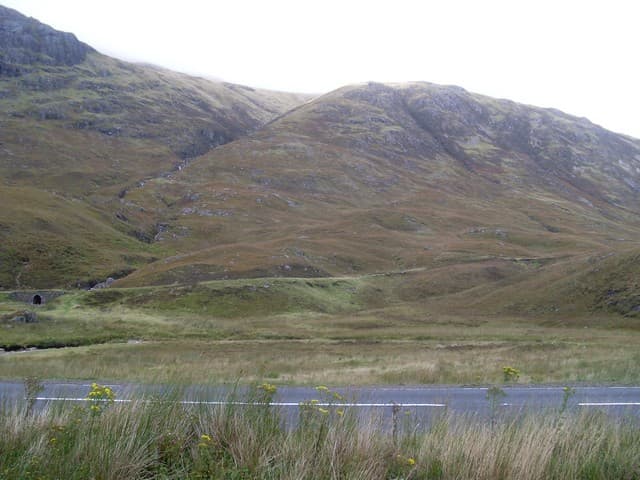
Glen Coe is the glen that defines the Highland landscape in the imagination — even for people who have never been to Scotland. The A82 cuts through a U-shaped trough flanked by the Three Sisters on the south and the Aonach Eagach on the north: two walls of dark volcanic rock, hanging corries, and a flat valley floor that feels like the bottom of something much larger than a glen. It is one of the most photographed places in Europe and it earns that attention every single time.
This is Lochaber at its most concentrated. The geology here is complex — Glen Coe is a volcanic caldera, collapsed inward 420 million years ago, and the dark rhyolite and andesite are unlike the granite of the Cairngorms or the sandstone of the northwest. The result is a landscape of unusual harshness: sheer walls, fractured gullies, and ridges that break into pinnacles. The Aonach Eagach is the longest and finest Grade 2/3 ridge scramble on the Scottish mainland. Bidean nam Bian (1150m), the highest peak in Argyll, hides behind the Three Sisters and rewards those prepared to earn it.
The glen is managed by the National Trust for Scotland and carries the associated visitor infrastructure — a well-run visitor centre, good interpretation of the 1692 massacre, and formal car parks. None of this diminishes the experience on the hill. Within fifteen minutes of leaving any car park you are in genuine mountain terrain. Go in May or September if you want the light, lower crowds, and the glen at its most atmospheric.
Looking for the Skyfall road? That is Glen Etive, the nineteen-mile single-track dead end that turns south off the A82 at Kings House — it has its own guide.
The road in
Single-track road etiquette
Pull into passing places to let oncoming vehicles pass. Don't park in passing places. If a faster vehicle is behind you, pull over and let them past. Do not reverse at speed — wait in a passing place.
Parking3 spots
NTS Glencoe Visitor Centre
100+ cars
Pay and display — NTS members free; check the machine
NTS Glencoe Visitor Centre parking guide — cost, grid ref & arrival times →
Coire Gabhail / Three Sisters layby
30 cars
Free
Overflow onto verge common in summer; arrive before 9am.
Altnafeadh / Kings House
20 cars
Free
East end; for Buachaille Etive Mor approaches.
Hills from Glen Coe21 Munros · 8 Corbetts · 5 Grahams
Aonach Eagach - Meall Dearg
952.3m
Garbh Bheinn
867m
Buachaille Etive Beag - Stob Coire Raineach
924.5m
Buachaille Etive Beag - Stob Dubh
956.7m
Aonach Eagach - Sgorr nam Fiannaidh
967.7m
Stob na Doire
1010.5m
Buachaille Etive Mor - Stob Dearg
1021.4m
Buachaille Etive Mor - Stob na Broige
953.4m
Stob Coire Sgreamhach
1072m
Bidean nam Bian
1149.4m
Meall na Duibhe
571.4m
Beinn a' Chrulaiste
857m
Pap of Glencoe
742.4m
Am Bodach
1031.8m
Beinn Maol Chaluim
906.3m
Na Gruagaichean
1054.3m
Stob Coire a' Chairn
981.3m
Meall Mor
676m
Beinn Mhic Chasgaig
864m
Stob Ban
999.7m
Mam na Gualainn
796.5m
Binnein Mor
1130m
Creise
1099.8m
Sgurr Eilde Mor
1010m
An Gearanach
981.5m
Sgurr a' Mhaim
1099m
Stob Dubh
883m
Glas Bheinn
789.8m
Sgurr na h-Ulaidh (Sgor na h-Ulaidh)
994m
Meall a' Bhuiridh
1107.9m
Binnein Beag
943m
Meall Lighiche
772m
Sgorr a' Choise
661.8m
Mullach nan Coirean
939.3m
Tom Meadhoin
621.8m
Doire Ban
566m
Beinn na Cloiche
645.1m
Bothies in the glen1 in range
Wild swimming3 spots nearby
What's in the glen
Three Sisters viewpoint
The Three Sisters — Beinn Fhada, Gearr Aonach, Aonach Dubh — are the three ridges projecting north from Bidean nam Bian. Best seen from the Study (An Stùidhe) viewpoint on the A82. The composition of dark rock, hanging corries and the flat valley floor below is one of the most photographed views in Scotland.
Aonach Eagach
The north wall of the glen — one of the finest ridge scrambles on the Scottish mainland. A Grade 2–3 scramble requiring hands-on scrambling skills and a head for heights. In winter it is a serious mountaineering route requiring full winter kit.
Signal Rock
According to tradition, the signal given from this rock in February 1692 initiated the Massacre of Glencoe, in which 38 members of the MacDonald clan were killed by soldiers billeted with them. The NTS Glencoe Visitor Centre nearby has detailed historical interpretation.
Glencoe Massacre Memorial
The cairn memorial at the NTS visitor centre commemorates the 1692 massacre. The massacre, ordered by the government of King William III, became a defining moment in Scottish history and the glen has carried a sombre weight ever since.
River Coe
Check the current river level before attempting crossings — SEPA river gauge ↗
Our take
Glen Coe is non-negotiable. If you come to Scotland for mountains, you come here — there is no substitute for standing under the Three Sisters on a clear October morning when the frost is still on the grass and the Aonach Eagach ridge is lit orange. The visitor centre is good; the massacre history matters and should be read. The car parks fill fast in July and August: be there before nine or accept the layby scramble. Altnafeadh at the east end is underused — park there for Buachaille and you avoid the worst of the visitor centre crowds entirely.
Hoping to sleep out? Don't fight for space on the busy glen floor — the classic camp is one glen over, at the head of Glen Etive, the opening entry in our pick of Scotland's 25 finest wild pitches.
The Aonach Eagach should only be attempted by people who can genuinely scramble — it is not a hard walk with some hands-on bits, it is a sustained scramble with real exposure and no safe descent until the end. If you are not sure whether you qualify, you do not qualify yet. Take a course first.
History
In the early hours of 13 February 1692, soldiers billeted in the homes of the MacDonalds of Glencoe turned on their hosts and killed 38 men, women and children. The orders had come from the government of King William III — the massacre was carried out as punishment for the MacIain MacDonalds' late signature of the oath of allegiance. The killings were compounded not by their scale, which was modest by the standards of the time, but by the violation of Highland hospitality that had housed the soldiers for twelve days before the order was given.
The legal and political fallout rumbled for years. A parliamentary inquiry censured those responsible but produced no prosecutions. The Campbells, who formed a significant part of the government force, became forever associated with the killings in popular memory — an association that shapes attitudes in the glen to this day. The NTS visitor centre handles the history honestly and without melodrama. The Signal Rock, where tradition says the fatal signal was given, sits in woodland near the visitor centre and is worth seeking out for the quieter, more personal perspective it provides on events that have never quite been laid to rest.
Practical
- Mobile signal
- Patchy EE/Vodafone along the A82 near the visitor centre. Signal deteriorates rapidly in the corries. No signal at Altnafeadh. Assume no signal once you leave the main road.
- Midges
- High(4/5)
- Land manager
- National Trust for Scotland ↗
- Conservation cull operations may be ongoing — access remains welcomed year-round. Volunteer stalkers shoot from high seats away from main paths.
- Public transport
- Scottish Citylink X82 (Glasgow–Fort William) stops at Glencoe Village, Ballachulish and Kings House (Altnafeadh). Summer frequency is 4–5 services per day each way.
- Dogs
- On lead — livestock or ground-nesting birds present.
Map
Hills (green), bothies (brown), parking (blue), wild swimming (light blue), landmarks (dark red).
Nearby glens
Scotland outdoor updates
Route guides, condition reports and seasonal picks — once a month, no noise.
Glen Coe — common questions
- What kind of road runs through Glen Coe?
- Single-track with passing places. Build in extra time for the approach.
- Can I take a motorhome or campervan into Glen Coe?
- Glen Coe works for motorhomes and campervans. Just take the single-track stretches steadily and use the passing places so local traffic can get past.
- Are there midges in Glen Coe?
- Expect a severe midge season in Glen Coe (4/5), running late May to September. The worst of it comes on sheltered, humid evenings — breezy spots and the high tops stay clearer. Smidge and a head net earn their place from May onwards.
- Can I wild camp in Glen Coe?
- You can. Scotland's Land Reform Act 2003 gives a right to wild camp on most unenclosed land, subject to the Scottish Outdoor Access Code: stay off enclosed agricultural ground, keep numbers small, leave no trace. Note the Loch Lomond and Trossachs Camping Management Zones and their seasonal restrictions do not cover Glen Coe.
- Can I get to Glen Coe without a car?
- Scottish Citylink X82 (Glasgow–Fort William) stops at Glencoe Village, Ballachulish and Kings House (Altnafeadh). Summer frequency is 4–5 services per day each way.