Glen
Glen Roy
The Parallel Roads National Nature Reserve — three glacial lake shorelines etched into the hillsides like contour lines drawn by giants.
- Munros
- 2
- Corbetts
- 2
- Grahams
- 4
- Highest peak
- Beinn a' Chaorainn (1049.1m)
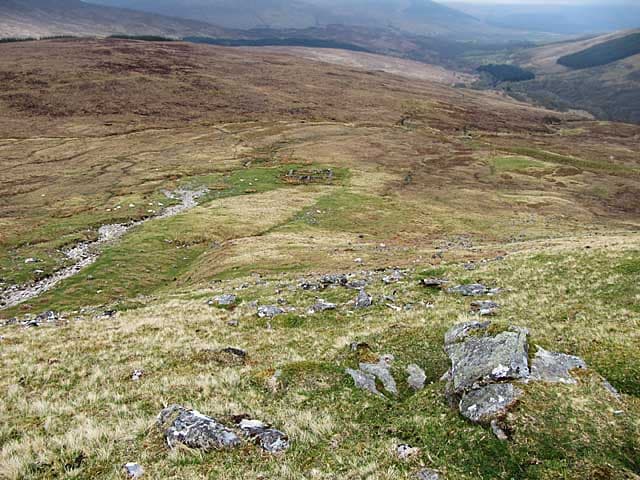
Glen Roy is a National Nature Reserve visited specifically for one geological phenomenon: the Parallel Roads — three horizontal terraces visible across both sides of the glen at 260m, 325m, and 350m. These are the shorelines of glacial lakes that filled the glen as the last ice age ended, each terrace marking a different lake level as the ice dam at the glen's mouth lowered in stages. The effect, seen from the road below, is of three perfectly level lines drawn across the hillsides — the straight edge precision is striking even when you know the explanation.
Charles Darwin visited in 1838 and concluded (incorrectly) that the terraces were marine — a significant error he later acknowledged. Louis Agassiz correctly identified them as ice-dammed lake shorelines in 1840. The glen is single-track from Roybridge and ends at the head of the valley. No specific trail is needed; the roads and viewpoints from the valley floor give the best overview of the Parallel Roads.
The road in
Single-track road etiquette
Pull into passing places to let oncoming vehicles pass. Don't park in passing places. If a faster vehicle is behind you, pull over and let them past. Do not reverse at speed — wait in a passing place.
Parking2 spots
Parallel Roads viewpoint layby
5 cars
Free
Small rough layby at the NNR viewpoint sign — the best spot to see all three terraces simultaneously. 4-5 cars only.
Roybridge village
Village street
Free
Park in Roybridge village near the station and walk or cycle the glen road.
Hills from Glen Roy2 Munros · 2 Corbetts · 4 Grahams
What's in the glen
Parallel Roads
The Parallel Roads of Glen Roy are horizontal terraces visible across the hillsides — shorelines of glacial lakes that filled the glen at the end of the last Ice Age. Three lake levels left three terraces between 260m and 350m. Charles Darwin came here in 1838 and got the explanation wrong (he thought they were marine terraces). Louis Agassiz correctly identified them as ice-dammed lake shorelines in 1840. The site is a National Nature Reserve.
Our take
The Parallel Roads are one of those features that sounds dull in description and is genuinely striking in person. Drive the glen slowly, stop at the viewpoints, and take time to look at both hillsides simultaneously — the three terraces are most legible from the valley floor. The hills above are decent walking country but the geology is the reason to come.
History
The scientific debate over the Parallel Roads ran for much of the 19th century. Charles Darwin visited Glen Roy in June 1838, spending several days making detailed observations. He published a paper arguing the terraces were ancient sea beaches, formed when the land stood lower and the sea level was higher. It was one of his few major scientific errors.
Two years later, the Swiss geologist Louis Agassiz visited Scotland and proposed the glacial theory — that ice sheets had covered much of Europe and Scotland. He identified the Glen Roy terraces as shorelines of glacial lakes dammed by ice, not marine beaches. Darwin was forced to concede the point in later editions of his work, calling it "a great failure." The glen is now a National Nature Reserve and the Parallel Roads are a scheduled monument. The geological evidence for three distinct lake levels — at 260m, 325m and 350m — is now well understood.
Practical
- Mobile signal
- Signal at Roybridge. Patchy in the lower glen, none at the head.
- Midges
- Moderate(3/5)
- Public transport
- Roybridge is served by the West Highland Line. The glen road is 2km from the station.
- Dogs
- On lead — livestock or ground-nesting birds present.
Map
Hills (green), bothies (brown), parking (blue), wild swimming (light blue), landmarks (dark red).
Nearby glens
Scotland outdoor updates
Route guides, condition reports and seasonal picks — once a month, no noise.
Glen Roy — common questions
- What's the road into Glen Roy like?
- Single-track with passing places. Give yourself more driving time than the map suggests.
- Is Glen Roy suitable for motorhomes and campervans?
- Yes — Glen Roy is suitable for motorhomes and campervans. Take care on any single-track sections and use passing places to let local traffic past.
- How bad are the midges in Glen Roy?
- Glen Roy's midge rating is 3/5 — significant from late May to September. Sheltered, humid evenings are the worst; high wind and the high tops are safest. Carry Smidge and a head net from May onwards.
- Is wild camping allowed in Glen Roy?
- Wild camping in Scotland is legal under the Land Reform Act 2003 on most unenclosed land, subject to the Scottish Outdoor Access Code. Avoid enclosed agricultural ground, camp in small numbers, and leave no trace. The Loch Lomond and Trossachs Camping Management Zones (which restrict wild camping in marked areas March-September) do not apply to Glen Roy.
- Is there public transport to Glen Roy?
- Roybridge is served by the West Highland Line. The glen road is 2km from the station.