Graham · Glen Coe & Lochaber
Cnap Cruinn
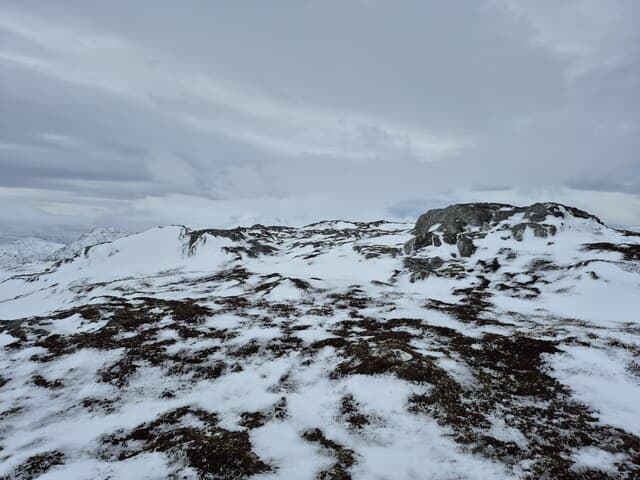
A round knoll between Loch Treig and the upper Spean, looking south to the Easains and west toward the Grey Corries. The summit is a small rock rib at the end of a long heathery rib — pleasingly out of the way.
Quick facts
- Height
- 741.9m/ 2434ft
- Prominence
- 245 m
- Distance
- ~14 km
- Ascent
- ~608 m
- Time
- 4–7 hrs
- Grid ref
- NN302774
- Parking
- NN349803
- Nearest city
- Fort William· 20km
- Dogs
- Dogs on lead required near livestockDog-friendly guide ↗
Height and prominence cross-checked against the Database of British and Irish Hills (CC BY).
No GPX track yet
Walked this route? Share your track to help other walkers.
Standard route
moorland path 20% · bog and heather 50% · grassy upper slopes 20% · summit area 10%
Take the West Highland Line to Tulloch Station or drive to the carpark there, then walk south-west on the access track past the Easains hostel before striking up the long open north-east ridge to the rib.
Terrain
Estate access track, then trackless tussock and short heather. The summit rib gives a moment of rocky interest in an otherwise grassy day.
In winter
The Creag Meagaidh SAIS forecast covers this ground; the north-east flank holds windslab after westerlies. River crossings down low can become difficult after thaws given the bare ground catchment from the surrounding hills.
Kit for this: the winter Munro kit list · which boots take crampons
This hill is in the Creag Meagaidh SAIS forecast area. Check SAIS forecasts in winter (December–April).
Best time of year
Getting there
- Glasgow2h 28m
- Edinburgh3h 59m
OS maps: OS Landranger 41
Mobile signal: No signal in this remote Rannoch/Etive area
Current conditions
Daylight Today
- Sunrise
- 07:49
- Sunset
- 18:21
- Civil dawn
- 07:11
- Civil dusk
- 19:00
NOAA Solar Calculator · 14 October 2026
Around Cnap Cruinn on the SCOT network
Getting there, basing yourself, and what to do off the hill.
Cnap Cruinn — common questions
- What difficulty is Cnap Cruinn?
- On the OutdoorSCOT scale, Cnap Cruinn comes in at 4/5 — challenging. Expect roughly 14km and 608m of ascent on the usual route — 4-7 hours for most parties. Ground conditions: Estate access track, then trackless tussock and short heather.
- How much drop does Cnap Cruinn have?
- The drop is 245m: measured from the summit of Cnap Cruinn down to the saddle joining it to higher terrain.
- Where's the parking for Cnap Cruinn?
- Park at NN349803. Double-check the grid reference on an OS map first; informal laybys here fill early in high season.
- What's the best month to climb Cnap Cruinn?
- Aim for April, May, June, July, August, September, October on Cnap Cruinn. In the remaining months treat it as a winter hill — full kit, solid navigation, and a look at the relevant SAIS avalanche forecast before you go.
- Can dogs go up Cnap Cruinn?
- Dogs are fine on a lead. The route passes livestock or ground-nesting bird habitat, so keep them close throughout.
- Will I get phone signal on Cnap Cruinn?
- No signal in this remote Rannoch/Etive area
- Is Cnap Cruinn safe in winter?
- The Creag Meagaidh SAIS forecast covers this ground; the north-east flank holds windslab after westerlies. River crossings down low can become difficult after thaws given the bare ground catchment from the surrounding hills.
Get the OutdoorSCOT weekly
One email a week — new route, hill and bothy guides, seasonal conditions and the odd hard-won lesson. No spam, unsubscribe in one click.