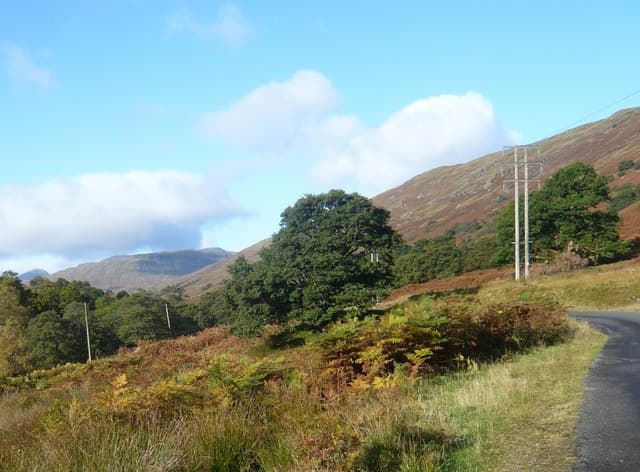
Glen
Glen Lochay
Three uncrowded Munros above a Perthshire glen shaped by drove roads, Campbell estates and a post-war hydroelectric scheme that runs through the mountain.
- Munros
- 8
- Corbetts
- 5
- Grahams
- 1
- Highest peak
- Ben Lawers (1214.3m)
Glen Lochay runs west from Killin along the River Lochay toward the hills above Tyndrum. The lower glen is marked by the Lochay hydroelectric scheme — part of the North of Scotland Hydro-Electric Board's 1950s Breadalbane programme. The scheme involved a dam, diversion tunnels and an underground power station at Cashlie driven into the hillside. The infrastructure is visible in the lower glen in the form of access tracks and equipment buildings; the upper glen beyond Kenknock farm is undisturbed moorland.
Three Munros sit on the glen's northern flank: Beinn Heasgarnich (1076m), Creag Mhor (1047m) and Meall Glas (959m). Beinn Heasgarnich is the most substantial — a broad hill with a long approach and excellent views across the Breadalbane plateau toward Ben Lawers and the Tarmachan ridge. The approach from the glen road via Kenknock is straightforward in clear conditions; the summit plateau is wide and featureless, and navigation in poor visibility requires care. All three hills see a fraction of the weekend traffic that nearby Ben Lawers attracts, which for some people is the entire point.
The glen road is single-track from Killin to the Kenknock track end — 10km of passing-place driving above the river, with the hills rising on both sides. Beyond Kenknock, the track continues on foot toward the upper watershed. There is almost nothing at the end of the road except the hills.
The road in
Single-track road etiquette
Pull into passing places to let oncoming vehicles pass. Don't park in passing places. If a faster vehicle is behind you, pull over and let them past. Do not reverse at speed — wait in a passing place.
End of road
The road ends at the Kenknock farm track end, 10km west of Killin. Beyond is foot-only access into the upper glen and the Munro approaches. The underground power station at Cashlie is in the lower glen but not publicly accessible.
Parking2 spots
Kenknock track end
8 cars
Free
Rough track end near Kenknock farm. Main parking for hill approaches in the upper glen.
Killin layby (Dochart)
15 cars
Free
Layby at the glen mouth near the Falls of Dochart. Useful for the lower glen walk.
Hills from Glen Lochay8 Munros · 5 Corbetts · 1 Grahams
Beinn nan Oighreag
909.6m
Meall Ghaordaidh
1039.8m
Meall nam Maigheach
778.9m
Stuc an Lochain (Stuchd an Lochain)
959.5m
Meall nan Tarmachan
1043.6m
Cam Chreag
861.7m
Meall a' Choire Leith
925.6m
Meall Corranaich
1067.2m
Meall nan Subh
806m
Meall Buidhe
932.1m
Sron a' Choire Chnapanaich (Sron a' Choire Chnapanich)
835m
Beinn Ghlas
1103.4m
Meall a' Mhuic
745.9m
Ben Lawers
1214.3m
Gravel cycling1 route nearby
What's in the glen
Falls of Lochay
A series of drops on the River Lochay near its confluence with the River Dochart at Killin — accessible on a short path from the road. Best in spate. Pairs well with the Falls of Dochart in Killin itself for a short waterfall circuit at the glen mouth.
Beinn Heasgarnich
Beinn Heasgarnich (1076m) is the highest and most rewarding of the three Lochay Munros — a broad summit with panoramic views across the Breadalbane plateau toward Ben Lawers, the Tarmachan ridge and Ben More. The approach from Kenknock is long (14km return, 900m ascent) but technically straightforward. Usually combined with Creag Mhor (1047m) to the west for a full ridge day. Rarely busy even at peak season.
River Lochay
Our take
Beinn Heasgarnich from Kenknock is a good Munro for a clear day when Ben Lawers is full of Ben Lawers crowds. The ascent is long but uncomplicated, the views from the summit are wide, and you will almost certainly have the ridge to yourself. Creag Mhor, usually combined with Heasgarnich, is excellent. Do not come to Glen Lochay expecting drama in the glen itself — the lower section is hydro infrastructure and farming, and the upper glen is open moor. The payoff is on the tops.
History
Glen Lochay was part of the vast Breadalbane estates of the Campbell earls — one of the largest landholdings in Scotland at their peak, running from Loch Awe in Argyll east to Aberfeldy. The Campbells of Breadalbane controlled this glen from at least the 17th century, and the drove road that ran through it — carrying cattle from highland grazings toward the Falkirk Tryst and the lowland markets — was an important economic artery. The Killin–Tyndrum corridor was a main drove route, and the River Lochay valley provided a relatively sheltered western approach to the hill passes.
The Breadalbane hydro-electric scheme of the 1950s transformed the lower glen. The North of Scotland Hydro-Electric Board, operating under a post-war mandate to bring electricity to the Highlands, built a series of dams, tunnels and power stations across Perthshire and Argyll. The Lochay scheme included an underground power station at Cashlie — a turbine hall excavated inside the hillside, invisible from the glen floor. The scheme was part of a network of interconnected Breadalbane works that also affected Glen Lyon and Loch Tay. Locally the hydro construction brought employment in the late 1940s and early 1950s to an area that had seen sustained depopulation since the Highland Clearances.
Practical
- Mobile signal
- Signal in Killin. No signal in the upper glen.
- Midges
- Moderate(3/5)
- Public transport
- Bus to Killin from Stirling (Service 59). No public transport into the glen.
- Dogs
- On lead — livestock or ground-nesting birds present.
Map
Hills (green), bothies (brown), parking (blue), wild swimming (light blue).
Nearby glens
Scotland outdoor updates
Route guides, condition reports and seasonal picks — once a month, no noise.
Glen Lochay — common questions
- What's the road into Glen Lochay like?
- Single-track with passing places. The road ends at the Kenknock farm track end, 10km west of Killin. Beyond is foot-only access into the upper glen and the Munro approaches. The underground power station at Cashlie is in the lower glen but not publicly accessible.
- Is Glen Lochay suitable for motorhomes and campervans?
- Not recommended. Glen Lochay has narrow sections, tight turns, or limited passing space that make it difficult for motorhomes and large campervans. Park at the road end of a wider valley and continue on foot.
- How bad are the midges in Glen Lochay?
- Glen Lochay's midge rating is 3/5 — significant from late May to September. Sheltered, humid evenings are the worst; high wind and the high tops are safest. Carry Smidge and a head net from May onwards.
- Is wild camping allowed in Glen Lochay?
- Wild camping in Scotland is legal under the Land Reform Act 2003 on most unenclosed land, subject to the Scottish Outdoor Access Code. Avoid enclosed agricultural ground, camp in small numbers, and leave no trace. The Loch Lomond and Trossachs Camping Management Zones (which restrict wild camping in marked areas March-September) do not apply to Glen Lochay.
- Is there public transport to Glen Lochay?
- Bus to Killin from Stirling (Service 59). No public transport into the glen.