Glen
Glen Falloch
The A82 corridor north of Loch Lomond — Rob Roy cattle country, one of Scotland's oldest inns, a waterfall on the West Highland Way, and two Munros that earn their solitude.
- Munros
- 7
- Corbetts
- 2
- Grahams
- 3
- Bothies
- 1
- Wild swimming
- 1
- Highest peak
- Cruach Ardrain (1045.9m)
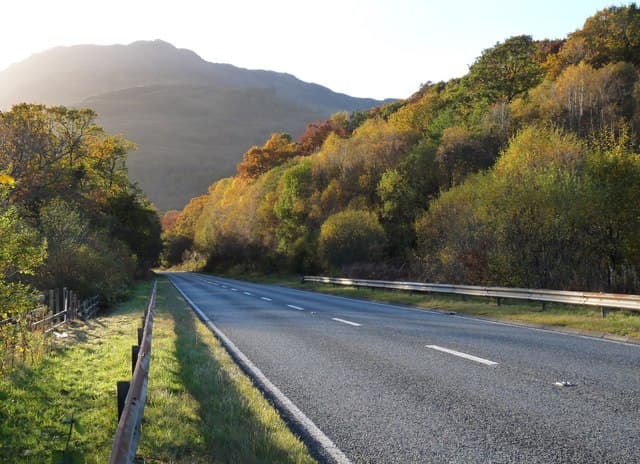
Glen Falloch carries the A82 north from Loch Lomond to Crianlarich — the main road corridor from Glasgow toward Fort William and Skye. The River Falloch runs the length of the glen below the road, and the West Highland Way follows the quieter east bank through birch and alder. The glen name comes from the Gaelic falachadh — hidden place — which describes the original character before the military road and then the A82 opened it up. It is now one of the most driven-through glens in Scotland.
The Falls of Falloch are a 20-minute detour from the A82 that most drivers skip. They are a wide curtain fall into a deep plunge pool, framed by oak and birch, best visited in spate when the River Falloch is running hard after rain. The West Highland Way passes directly by; long-distance walkers arriving here on Day 2 from Loch Lomond typically stop. Day trippers from Glasgow who stop on the way north often do not know the falls are there.
Inverarnan, at the southern end of the glen, has the Drovers Inn — a licensed premises since 1705, one of the oldest continuously-operating inns in Scotland. The inn sits on the old droving route from the Highland grazings to the Falkirk Tryst, where cattle from across the west Highlands were sold to Lowland buyers. The interior — low ceilings, taxidermy, peat smoke — has remained largely unchanged for generations. It is not a gastro pub.
The road in
Parking2 spots
Falls of Falloch layby
12 cars
Free
Signed layby on the A82 north of Inverarnan. The path to the falls takes about 10 minutes one way.
Inverarnan / Drovers Inn
20 cars
Free
Parking at the Drovers Inn for customers. The West Highland Way passes here.
Hills from Glen Falloch7 Munros · 2 Corbetts · 3 Grahams
Bothies in the glen1 in range
Wild swimming1 spot nearby
What's in the glen
Falls of Falloch
A wide curtain fall into a deep plunge pool on the River Falloch — framed by oak and birch, best in spate after heavy rain. The West Highland Way passes directly by on the east bank. 10-minute walk from the A82 layby. Most drivers on the A82 never stop; most West Highland Way walkers do.
Drovers Inn, Inverarnan
The Drovers Inn at Inverarnan has been a licensed premises since 1705, making it one of the oldest continuously-operating inns in Scotland. It served the droving trade that moved Highland cattle south through Glen Falloch to the Falkirk Tryst. The interior — low ceilings, taxidermy, open fire — has changed little. A West Highland Way landmark and a worthwhile stop on any northbound journey.
River Falloch
Our take
Glen Falloch rewards the decision to stop. The Falls take twenty minutes; the Drovers Inn at Inverarnan is worth a drink and an hour. Together they make a legitimate half-day from Glasgow or a natural break on the drive north. The hillwalking above the glen — Beinn Chabhair from Derrydaroch, An Caisteal from Crianlarich — is longer and wetter than the approach distances suggest, but the summits are uncrowded and the ridge between An Caisteal and Beinn a'Chroin is one of the better short ridges in the southern Highlands.
History
Glen Falloch was cattle country — MacGregor territory in the 17th and 18th centuries, and a main corridor for the droving trade that moved Highland cattle south to the Falkirk Tryst each autumn. Rob Roy MacGregor (1671–1734), whose territory centred on Loch Katrine and ranged into the Crianlarich hills, used the glen as a passage route and is associated with several sites nearby. The Drovers Inn at Inverarnan, established in 1705, served this trade — a waypoint for drovers moving cattle through the glen before the drove road was upgraded.
General Wade's military road programme of the 1720s and 1730s, built to move government troops through the Highlands after the 1715 Jacobite rising, ran through Glen Falloch. The road was the forerunner of the modern A82 and some sections of the original surface remain visible as a separate line alongside the modern road. Wade's roads were built partly to prevent future risings by enabling rapid troop movement — a strategy that did not prevent the 1745 rising but permanently changed Highland infrastructure.
Practical
- Mobile signal
- Good signal along the A82. Limited on hill routes above the glen.
- Midges
- Moderate(3/5)
- Public transport
- CityLink services (Glasgow–Fort William/Skye) stop at Inverarnan. West Highland Line train at Crianlarich.
- Dogs
- On lead — livestock or ground-nesting birds present.
Map
Hills (green), bothies (brown), parking (blue), wild swimming (light blue).
Nearby glens
Scotland outdoor updates
Route guides, condition reports and seasonal picks — once a month, no noise.
Glen Falloch — common questions
- What kind of road runs through Glen Falloch?
- A-road for the full length. Build in extra time for the approach.
- Can I take a motorhome or campervan into Glen Falloch?
- Glen Falloch works for motorhomes and campervans. Just take the single-track stretches steadily and use the passing places so local traffic can get past.
- Are there midges in Glen Falloch?
- Expect a significant midge season in Glen Falloch (3/5), running late May to September. The worst of it comes on sheltered, humid evenings — breezy spots and the high tops stay clearer. Smidge and a head net earn their place from May onwards.
- Can I wild camp in Glen Falloch?
- You can. Scotland's Land Reform Act 2003 gives a right to wild camp on most unenclosed land, subject to the Scottish Outdoor Access Code: stay off enclosed agricultural ground, keep numbers small, leave no trace. Note the Loch Lomond and Trossachs Camping Management Zones and their seasonal restrictions do not cover Glen Falloch.
- Can I get to Glen Falloch without a car?
- CityLink services (Glasgow–Fort William/Skye) stop at Inverarnan. West Highland Line train at Crianlarich.