Glen
Glen Tilt
A legal right-of-way forged in an 1847 court case — the historic through-route from Blair Atholl to Braemar through some of the most remote terrain in the southern Highlands.
- Length
- 24km
- Munros
- 9
- Corbetts
- 2
- Bothies
- 2
- Highest peak
- Beinn a' Ghlo - Carn nan Gabhar (1121.9m)
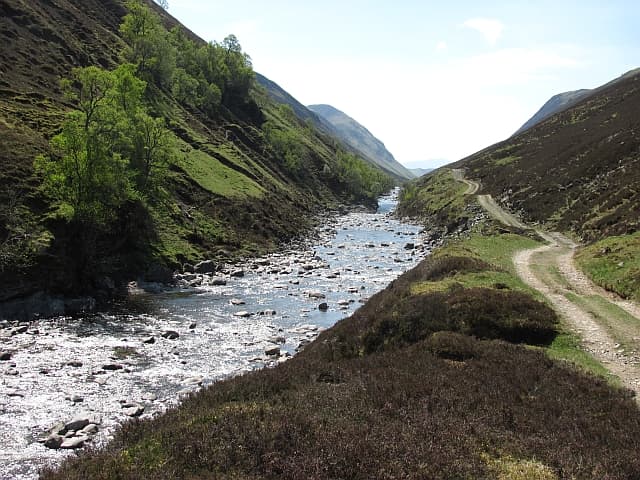
Glen Tilt runs north from Blair Atholl for 24km through the Atholl Estate to Forest Lodge, beyond which the public right-of-way continues on foot to Braemar via the Linn of Dee — a two-day through-route of around 30km that is one of the finest long-distance walks in Scotland. The glen is unusual in Scottish terms: it is technically a right-of-way, not a permissive path, established in law by a court case in 1847 when the Duke of Atholl attempted to close it to a botanical party led by Professor Balfour. The right to walk through it was won in court and the path through the glen is still exercised as a legal right today.
The landscape changes significantly along the glen's length. The lower section (accessible by car from Blair Atholl to Forest Lodge) is a broad valley with the River Tilt running over rapids and through pools. Beyond Forest Lodge the terrain narrows and rises, passing Gilbert's Bridge — a Victorian suspension bridge that sways — before reaching the Falls of Tarf at the remotest point, where the Bedford Memorial Bridge commemorates a drowning in 1879. Blair Atholl is served by train on the Perth–Inverness line: the glen is a 1km walk from the station.
The road in
Single-track road etiquette
Pull into passing places to let oncoming vehicles pass. Don't park in passing places. If a faster vehicle is behind you, pull over and let them past. Do not reverse at speed — wait in a passing place.
End of road
Forest Lodge. Beyond is the right-of-way on foot or bicycle only — the historical Tilt through-route to Braemar.
Parking1 spot
Old Blair car park
30 cars
Free
Start of the glen walk. Public toilets at Blair Atholl village (0.5km).
Hills from Glen Tilt9 Munros · 2 Corbetts
Carn a' Chlamain
963.5m
An Sgarsoch
1006.5m
Beinn a' Ghlo - Carn nan Gabhar
1121.9m
Beinn a' Ghlo - Braigh Coire Chruinn-bhalgain
1070m
Carn an Fhidhleir (Carn Ealar)
994m
Beinn Mheadhonach
900.9m
Carn an Righ
1029m
Beinn Bhreac
912.44m
Beinn a' Ghlo - Carn Liath
975.8m
Beinn Dearg
1008.7m
Beinn Iutharn Mhor
1045m
Bothies in the glen2 in range
What's in the glen
Gilbert's Bridge
A Victorian suspension bridge over the River Tilt — a delicate structure that sways noticeably. Part of the historic through-route from Blair Atholl to Braemar via the Linn of Dee (30km one way, typically two days).
Falls of Tarf
The Falls of Tarf mark the junction of the Tarf Water with the River Tilt, at the remotest part of the glen. The Bedford Memorial Bridge crosses the Tarf Water above the falls — the memorial commemorates Francis John Bedford, who drowned here in 1879.
River Tilt
Our take
Glen Tilt is for people who want to walk into a real wilderness from a railway station. Blair Atholl is accessible, the car park at Old Blair is free, and within an hour you are in a glen that feels genuinely remote. The through-route to Braemar is one of those Scottish classics that is well-known but rarely done — take two days, camp by the river, and cross the watershed in the morning. The legal history matters: you are exercising a right that was won at considerable effort. Use it.
History
In 1847, Professor John Hutton Balfour led a party of botanists through Glen Tilt on a collecting expedition. The Duke of Atholl had his gamekeepers block the path and attempted to physically prevent their passage. Balfour refused to turn back, and the resulting legal case — Balfour v Duke of Atholl — established that the right-of-way through Glen Tilt was a public right. The case shaped Scottish access law for the next 150 years and is frequently cited as a precursor to the Land Reform (Scotland) Act 2003. The glen is still technically a right-of-way, not a permissive path — you are exercising a legal right when you walk through it.
Practical
- Mobile signal
- Signal at Blair Atholl. None beyond the first few kilometres of the glen.
- Midges
- Moderate(3/5)
- Stalking estate
- Atholl Estates ↗
- Public transport
- Blair Atholl is served by train (Perth-Inverness line). The glen is a 1km walk from the station.
- Dogs
- On lead — livestock or ground-nesting birds present.
Map
Hills (green), bothies (brown), parking (blue), wild swimming (light blue), landmarks (dark red).
Nearby glens
Scotland outdoor updates
Route guides, condition reports and seasonal picks — once a month, no noise.
Glen Tilt — common questions
- What kind of road runs through Glen Tilt?
- Single-track with passing places. Forest Lodge. Beyond is the right-of-way on foot or bicycle only — the historical Tilt through-route to Braemar.
- Can I take a motorhome or campervan into Glen Tilt?
- We'd say no for larger vehicles: Glen Tilt's narrow road, tight turns and limited passing space punish motorhomes and big campervans. Leave the van at a road end elsewhere and come in on foot.
- Are there midges in Glen Tilt?
- Expect a significant midge season in Glen Tilt (3/5), running late May to September. The worst of it comes on sheltered, humid evenings — breezy spots and the high tops stay clearer. Smidge and a head net earn their place from May onwards.
- Can I wild camp in Glen Tilt?
- You can. Scotland's Land Reform Act 2003 gives a right to wild camp on most unenclosed land, subject to the Scottish Outdoor Access Code: stay off enclosed agricultural ground, keep numbers small, leave no trace. Note the Loch Lomond and Trossachs Camping Management Zones and their seasonal restrictions do not cover Glen Tilt.
- Can I get to Glen Tilt without a car?
- Blair Atholl is served by train (Perth-Inverness line). The glen is a 1km walk from the station.