Corbett · Central Highlands
Aonach Buidhe
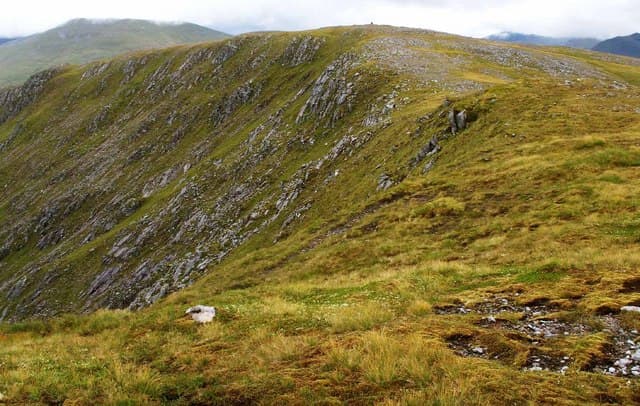
Aonach Buidhe — 'the yellow ridge' — is the broad rolling Corbett rising at the heart of the country between Glen Elchaig and Glen Cannich, deep in the empty hills west of Cannich. The 899m summit gives one of the lonelier vantage points in the western Highlands, looking south into the Glen Affric Munros and north over the Mullardoch range. No quick line up this one — every realistic route involves at least 25km round trip, and the hill is most commonly bagged from the Iron Lodge bothy as part of a multi-day round of the remote Glen Cannich Corbetts.
Gaelic: “high ridge, yellow” · Pronunciation: oeun-ach boo-yeh
Quick facts
- Height
- 899m/ 2949ft
- Prominence
- 474 m
- Distance
- ~30 km
- Ascent
- ~950 m
- Time
- 8–11 hrs
- Grid ref
- NH057324
- Parking
- NG937302
- Nearest
- Fort William· Inverness 62km
- Dogs
- Dogs on lead required near livestockDog-friendly guide ↗
Height and prominence cross-checked against the Database of British and Irish Hills (CC BY).
No GPX track yet
Walked this route? Share your track to help other walkers.
Standard route
estate track 35% · peat and heather 35% · broad ridge 20% · summit plateau 10%
The classic approach is from the road end at Killilan in Glen Elchaig (NG937302). Walk or cycle the estate track east up Glen Elchaig to Iron Lodge bothy (around 12km), then climb south-east onto the broad north ridge of Aonach Buidhe. The route gains the summit gradually across grass and peat. Alternative approaches from the Cannich side via Loch Mullardoch shorten the walk-in but add waterborne logistics. Allow 10–12 hours from Killilan on foot, less with bike.
Terrain
Estate track for the long approach. Beyond Iron Lodge, the ground turns to deep heather, peat hag and bog — slow underfoot in any conditions. The summit ridge itself is gentler, with firm grass and rock outcrops. The final cairn is small; in cloud the broad plateau demands accurate navigation.
In winter
Aonach Buidhe in winter is a serious expedition. The long approach freezes hard, the upper plateau holds deep drifts, and there is no easy bail-out. Most parties tackle it as a two-day round from Iron Lodge bothy with bivouac kit. The phone-signal blackspot here is among the largest in the western Highlands.
Kit for this: the winter Munro kit list · which boots take crampons
Best time of year
Getting there
- Glasgow3h 22m
- Edinburgh4h 49m
OS maps: OS Landranger 25
Mobile signal: No signal in the Iron Lodge / upper Loch Mullardoch country
Current conditions
Daylight Today
- Sunrise
- 07:52
- Sunset
- 18:22
- Civil dawn
- 07:13
- Civil dusk
- 19:01
NOAA Solar Calculator · 14 October 2026
Pair with
Curated multi-hill combinations from Aonach Buidhe.
Around Aonach Buidhe on the SCOT network
Getting there, basing yourself, and what to do off the hill.
Aonach Buidhe — common questions
- What difficulty is Aonach Buidhe?
- On the OutdoorSCOT scale, Aonach Buidhe comes in at 3/5 — moderately challenging. Expect roughly 30km and 950m of ascent on the usual route — 8-11 hours for most parties. Terrain: Estate track for the long approach.
- How prominent is Aonach Buidhe?
- Aonach Buidhe has 474m of topographic prominence — the height of its summit above the highest col connecting it to higher ground.
- Where should I park to climb Aonach Buidhe?
- Standard parking is at NG937302 near Fort William. Check the parking grid reference on an OS map before travel; informal laybys can fill on summer weekends.
- When should I climb Aonach Buidhe?
- The standard good-weather months for Aonach Buidhe are May, June, July, August, September, October. Outside those months, expect winter conditions on the high ground — full mountain kit, navigation skills, and a check of the SAIS avalanche forecast for the relevant region.
- Can I bring my dog up Aonach Buidhe?
- On a lead only — the route crosses ground with livestock or nesting-bird interest.
- What's mobile reception like on Aonach Buidhe?
- No signal in the Iron Lodge / upper Loch Mullardoch country
- Is Aonach Buidhe safe in winter?
- Aonach Buidhe in winter is a serious expedition. The long approach freezes hard, the upper plateau holds deep drifts, and there is no easy bail-out. Most parties tackle it as a two-day round from Iron Lodge bothy with bivouac kit. The phone-signal blackspot here is among the largest in the western Highlands.
Get the OutdoorSCOT weekly
One email a week — new route, hill and bothy guides, seasonal conditions and the odd hard-won lesson. No spam, unsubscribe in one click.