Graham · North-West Highlands
Beinn Bheag
Beinn Bheag (668m) — the little hill — perches above the upper reaches of the Inverbroom road in NH08, a small sandstone summit overshadowed by An Teallach to the south-west. The small cairn looks across the Strath More glen to the Fannichs and west to the great Torridonian cliffs of An Teallach's northern flanks. A quiet vantage on a popular touring route.
Gaelic: “mountain, small” · Pronunciation: bine vek
Quick facts
- Height
- 668.4m/ 2193ft
- Prominence
- 199 m
- Distance
- ~13 km
- Ascent
- ~548 m
- Time
- 4–6 hrs
- Grid ref
- NH085714
- Nearest
- Ullapool· Inverness 64km
- Dogs
- Dogs on lead required near livestockDog-friendly guide ↗
Height and prominence cross-checked against the Database of British and Irish Hills (CC BY).
No GPX track yet
Walked this route? Share your track to help other walkers.
Standard route
heather moorland 65% · grass slopes 25% · rocky summit 10%
Start from the layby south of Dundonnell on the A832 and follow the Allt Coir' a' Ghuibhsachain track south. Branch off east onto open hillside at around 350m and climb the heather-and-bilberry shoulder to the broad summit area. The small cairn sits on a low rise — line of sight from the col with the higher ground to the south.
Terrain
Stalkers track on the lower flank, then bog and tussock on the col approach. The upper slopes are short heather and grass with patches of slabby Torridonian rock. The summit dome is broad and gently rolling — easy on the legs but featureless in cloud.
In winter
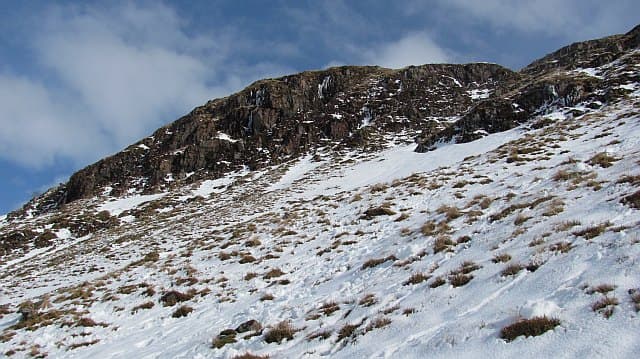
Beinn Bheag sees the full force of Atlantic snowfall driven over An Teallach. The summit dome is exposed and wind-scoured but drifts pile up against the small east-facing crags. Cornicing is rare on this gentle terrain.
Kit for this: the winter Munro kit list · which boots take crampons
Best time of year
Getting there
- Glasgow4h 4m
- Edinburgh4h 25m
OS maps: OS Landranger 19, OS Explorer 435
Mobile signal: Expect little. Remote north-west Highlands; no network reaches reliably.
Current conditions
Daylight Today
- Sunrise
- 07:52
- Sunset
- 18:22
- Civil dawn
- 07:13
- Civil dusk
- 19:01
NOAA Solar Calculator · 14 October 2026
Around Beinn Bheag on the SCOT network
Getting there, basing yourself, and what to do off the hill.
Beinn Bheag — common questions
- How hard is Beinn Bheag?
- We grade Beinn Bheag at 4/5, which puts it in challenging territory. The usual route is around 13km with 548m of climbing; allow 4-6 hours. Terrain: Stalkers track on the lower flank, then bog and tussock on the col approach.
- How prominent is Beinn Bheag?
- Beinn Bheag has 199m of topographic prominence — the height of its summit above the highest col connecting it to higher ground.
- When should I climb Beinn Bheag?
- The standard good-weather months for Beinn Bheag are May, June, July, August, September. Outside those months, expect winter conditions on the high ground — full mountain kit, navigation skills, and a check of the SAIS avalanche forecast for the relevant region.
- Can I bring my dog up Beinn Bheag?
- On a lead only — the route crosses ground with livestock or nesting-bird interest.
- What's mobile reception like on Beinn Bheag?
- Expect little. Remote north-west Highlands; no network reaches reliably.
- Is Beinn Bheag safe in winter?
- Beinn Bheag sees the full force of Atlantic snowfall driven over An Teallach. The summit dome is exposed and wind-scoured but drifts pile up against the small east-facing crags. Cornicing is rare on this gentle terrain.
Get the OutdoorSCOT weekly
One email a week — new route, hill and bothy guides, seasonal conditions and the odd hard-won lesson. No spam, unsubscribe in one click.