Corbett · North-West Highlands
Canisp
Canisp is the lonely Assynt Corbett that rises in glorious isolation from the lochan-strewn moorland between Loch Assynt and the back of Suilven. From most angles it looks plain and dome-like next to the spectacular spires of Suilven and Quinag — but with 689m of prominence it is one of the most freestanding hills in Britain, and the summit view of Suilven from directly across the bealach is the textbook image of Assynt. Cambrian quartzite caps the top above a base of ancient Torridonian sandstone.
Quick facts
- Height
- 847m/ 2779ft
- Prominence
- 689 m
- Distance
- ~15 km
- Ascent
- ~745 m
- Time
- 5–8 hrs
- Grid ref
- NC202187
- Parking
- NC234153
- Nearest
- Ullapool· Inverness 87km
- Dogs
- Dogs on lead required near livestockDog-friendly guide ↗
Height and prominence cross-checked against the Database of British and Irish Hills (CC BY).
No GPX track yet
Walked this route? Share your track to help other walkers.
Standard route
moorland path 25% · heather slope 35% · quartzite slope 30% · summit area 10%
The classic line starts from the lay-by on the A837 at Loch Awe, taking the stalkers path that runs north toward Suileag bothy. After around 3km the path approaches the south-east shoulder of Canisp — leave it and climb the broad pathless flank of grass and quartzite straight up to the summit. Around 15km return with 745m of ascent. There is no scrambling and no exposure, just open hill walking on rough moorland and stony upper slopes. Return by the same line.
Terrain
The Suileag path is firm peat and stone, generally well drained. Off the path the moor is wet and tussocky — wet feet are likely on the approach. The upper hill is quartzite scree and small slabs, with the summit area broad enough to need bearing-work in mist. No exposure but the open ground here gives no shelter at all from wind, which can be ferocious.
In winter
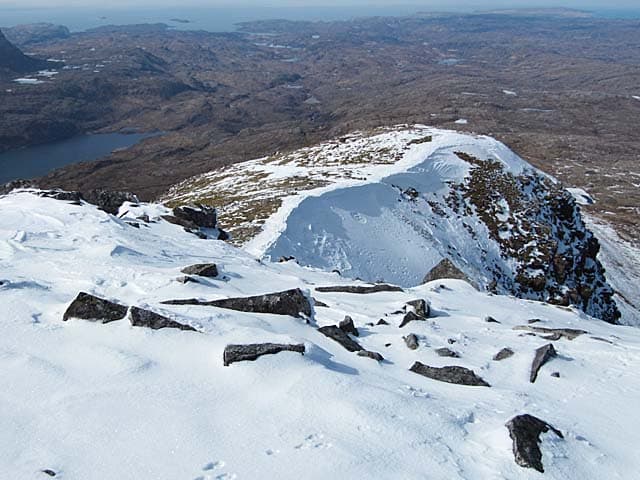
A hill that gives a real sense of arctic emptiness in winter — long approach across snow-covered moor with no shelter, and the summit dome above 700m takes the full force of any prevailing wind. Avalanche risk is low on the broad slopes but cornicing can occur on the east shoulder above the small loch corrie. The A837 is generally kept open but the lay-by can drift up in easterly storms.
Kit for this: the winter Munro kit list · which boots take crampons
Best time of year
Getting there
- Glasgow5h 55m
- Edinburgh5h 7m
OS maps: OS Landranger 15
Mobile signal: No signal on this isolated Assynt peak
Current conditions
Daylight Today
- Sunrise
- 07:52
- Sunset
- 18:20
- Civil dawn
- 07:13
- Civil dusk
- 19:00
NOAA Solar Calculator · 14 October 2026
Pair with
Curated multi-hill combinations from Canisp.
Around Canisp on the SCOT network
Getting there, basing yourself, and what to do off the hill.
Canisp — common questions
- What difficulty is Canisp?
- On the OutdoorSCOT scale, Canisp comes in at 3/5 — moderately challenging. Expect roughly 15km and 745m of ascent on the usual route — 5-8 hours for most parties. Underfoot: The Suileag path is firm peat and stone, generally well drained.
- What is Canisp's prominence?
- 689m of prominence. That's the vertical drop from the summit to the col that links Canisp to the next higher ground.
- Where do I park for Canisp?
- Most walkers start from NC234153 near Ullapool. Verify the grid reference on an OS map before you set off — space is tight on busy summer weekends.
- When is the best time to climb Canisp?
- May, June, July, August, September give the most reliable conditions on Canisp. Beyond that window the high ground turns wintry: carry full mountain kit, be confident navigating, and check the SAIS avalanche forecast for the area.
- Is Canisp dog-friendly?
- Yes, but dogs must be kept on a lead — there is livestock or ground-nesting bird interest on the route.
- Is there mobile signal on Canisp?
- No signal on this isolated Assynt peak
- Is Canisp safe in winter?
- A hill that gives a real sense of arctic emptiness in winter — long approach across snow-covered moor with no shelter, and the summit dome above 700m takes the full force of any prevailing wind. Avalanche risk is low on the broad slopes but cornicing can occur on the east shoulder above the small loch corrie. The A837 is generally kept open but the lay-by can drift up in easterly storms.
Get the OutdoorSCOT weekly
One email a week — new route, hill and bothy guides, seasonal conditions and the odd hard-won lesson. No spam, unsubscribe in one click.