Donald · Borders
Whitehope Heights
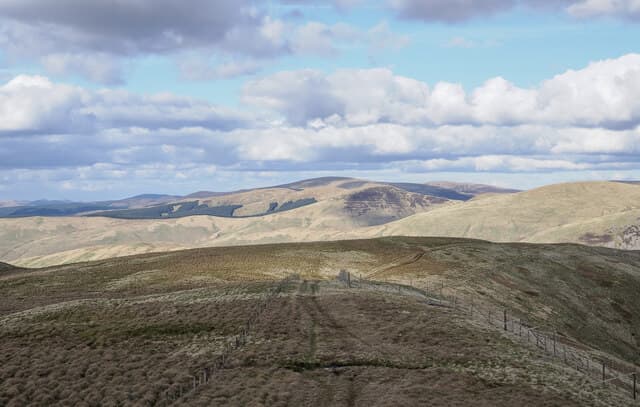
Whitehope Heights (637m) is a rolling top in the Tweedsmuir massif above the Devil's Beef Tub, looking down on the A701 watershed between the Tweed and Annan. A small cairn marks the highest point of a broad grassy crown that links Annanhead Hill and Great Hill in an obvious skyline. Few walkers visit for its own sake; most pass over on round trips taking in Hart Fell or Chalk Rig Edge.
Quick facts
- Height
- 637m/ 2090ft
- Prominence
- 109 m
- Distance
- ~12 km
- Ascent
- ~478 m
- Time
- 3–5 hrs
- Grid ref
- NT095139
- Parking
- NT103145
- Nearest city
- Dumfries· 40km
- Dogs
- Dogs on lead required near livestockDog-friendly guide ↗
Height and prominence cross-checked against the Database of British and Irish Hills (CC BY).
No GPX track yet
Walked this route? Share your track to help other walkers.
Standard route
grass moorland 80% · heather patches 15% · summit area 5%
Begin at the Devil's Beef Tub viewpoint on the A701 at NT060128 and follow the Annandale Way fence northwards over Annanhead Hill before drifting east onto Whitehope Heights — roughly 12km return with 478m of ascent. The going is on close-cropped sheep grass with shallow peat hags near the summit. The escarpment dropping into the Beef Tub itself is steep and undercut — keep clear of the edge in mist.
Terrain
Smooth grazed grass and short rush make this a comfortable walk underfoot, but the broad summit plateau has limited fix-points. The fence line from Annanhead is reliable; once away from it the going gets tussocky and rolling. The Beef Tub rim is the dominant terrain feature and a useful eastern handrail throughout.
In winter
The A701 watershed catches drifting snow that can plug the road for days, and Whitehope Heights sees this same weather first-hand. Cornices build along the steep Beef Tub headwall; verglas forms on the cropped grass after thaw–freeze cycles. Stick to the fence and stay back from the rim.
Kit for this: the winter Munro kit list · which boots take crampons
Best time of year
Getting there
- Glasgow2h 43m
- Edinburgh1h 29m
OS maps: OS Landranger 78
Mobile signal: Decent up top; EE behaves well. Smooth Tweeddale viewpoint.
Current conditions
Daylight Today
- Sunrise
- 07:41
- Sunset
- 18:18
- Civil dawn
- 07:04
- Civil dusk
- 18:55
NOAA Solar Calculator · 14 October 2026
Around Whitehope Heights on the SCOT network
Getting there, basing yourself, and what to do off the hill.
Whitehope Heights — common questions
- How difficult is Whitehope Heights?
- Whitehope Heights carries a 3/5 (moderately challenging) grade on the OutdoorSCOT scale. Count on about 12km, 478m of ascent and a 3-5 hour day on the standard route. Underfoot: Smooth grazed grass and short rush make this a comfortable walk underfoot, but the broad summit plateau has limited fix-points.
- What is Whitehope Heights's prominence?
- 109m of prominence. That's the vertical drop from the summit to the col that links Whitehope Heights to the next higher ground.
- Where do I park for Whitehope Heights?
- Most walkers start from NT103145. Verify the grid reference on an OS map before you set off — space is tight on busy summer weekends.
- When is the best time to climb Whitehope Heights?
- March, April, May, June, July, August, September, October, November give the most reliable conditions on Whitehope Heights. Beyond that window the high ground turns wintry: carry full mountain kit, be confident navigating, and check the SAIS avalanche forecast for the area.
- Is Whitehope Heights dog-friendly?
- Yes, but dogs must be kept on a lead — there is livestock or ground-nesting bird interest on the route.
- Is there mobile signal on Whitehope Heights?
- Decent up top; EE behaves well. Smooth Tweeddale viewpoint.
- Is Whitehope Heights safe in winter?
- The A701 watershed catches drifting snow that can plug the road for days, and Whitehope Heights sees this same weather first-hand. Cornices build along the steep Beef Tub headwall; verglas forms on the cropped grass after thaw–freeze cycles. Stick to the fence and stay back from the rim.
Get the OutdoorSCOT weekly
One email a week — new route, hill and bothy guides, seasonal conditions and the odd hard-won lesson. No spam, unsubscribe in one click.