Donald · Borders
Croft Head
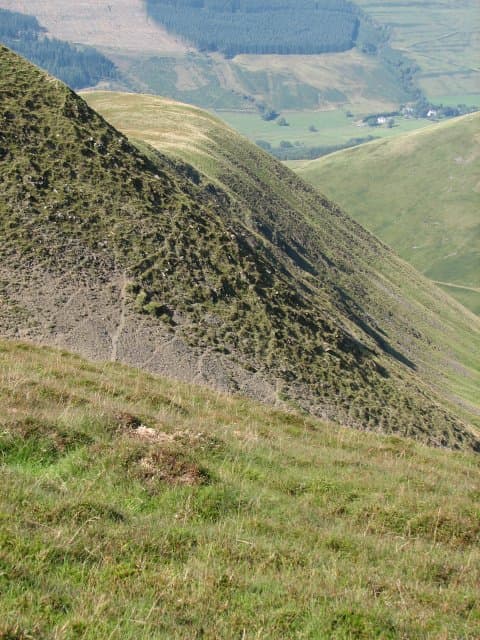
Croft Head (636m) is a rough little hill at the eastern end of the Moffat Hills, where the Southern Upland Way climbs out of Selcoth and Ettrick. Steep flanks of crag and scree drop south into Selcoth Burn — unusual for this rolling country — and the summit itself is little more than a patch of bare peat. From the top you look directly across to the Loch Fell ridge and west into the Moffat horseshoe.
Quick facts
- Height
- 636.2m/ 2087ft
- Prominence
- 194 m
- Distance
- ~12 km
- Ascent
- ~477 m
- Time
- 3–5 hrs
- Grid ref
- NT153056
- Parking
- NT159058
- Nearest city
- Dumfries· 34km
- Dogs
- Dogs on lead required near livestockDog-friendly guide ↗
Height and prominence cross-checked against the Database of British and Irish Hills (CC BY).
No GPX track yet
Walked this route? Share your track to help other walkers.
Standard route
grass moorland 80% · heather patches 15% · summit area 5%
The natural line follows the Southern Upland Way south-east from the parking at NT159058 below Selcoth, then breaks north up steep grass and scree onto Croft Head's prominent shoulder — 12km with 477m of ascent. The Southern Upland Way provides reliable navigation for most of the day; the final pull is path-free over short grass and the occasional rib of greywacke. Return by the same route.
Terrain
Selcoth Burn carves a steep gorge into the southern flank, with scree slopes and the small crag of Cat Shoulder breaking the otherwise grassy approach. The summit plateau is bare peat with sparse tussock cover. Care is needed on the steep upper slope when wet — greasy turf over rotten greywacke gives poor footing.
In winter
Croft Head's steep southern slopes hold ice well into spring and the Selcoth crags grow short ice lines in cold spells. Verglas on the greywacke ribs of the summit slope is the main hazard, along with corniced edges above Selcoth. The Southern Upland Way may be drifted shut in February.
Kit for this: the winter Munro kit list · which boots take crampons
Best time of year
Getting there
- Glasgow2h 44m
- Edinburgh2h 39m
OS maps: OS Landranger 79
Mobile signal: Good signal throughout; solid on EE and Vodafone. Southern Uplands viewpoint.
Current conditions
Daylight Today
- Sunrise
- 07:41
- Sunset
- 18:18
- Civil dawn
- 07:04
- Civil dusk
- 18:55
NOAA Solar Calculator · 14 October 2026
Around Croft Head on the SCOT network
Getting there, basing yourself, and what to do off the hill.
Croft Head — common questions
- How hard is Croft Head?
- We grade Croft Head at 3/5, which puts it in moderately challenging territory. The usual route is around 12km with 477m of climbing; allow 3-5 hours. Ground conditions: Selcoth Burn carves a steep gorge into the southern flank, with scree slopes and the small crag of Cat Shoulder breaking the otherwise grassy approach.
- How much drop does Croft Head have?
- The drop is 194m: measured from the summit of Croft Head down to the saddle joining it to higher terrain.
- Where's the parking for Croft Head?
- Park at NT159058. Double-check the grid reference on an OS map first; informal laybys here fill early in high season.
- What's the best month to climb Croft Head?
- Aim for March, April, May, June, July, August, September, October, November on Croft Head. In the remaining months treat it as a winter hill — full kit, solid navigation, and a look at the relevant SAIS avalanche forecast before you go.
- Can dogs go up Croft Head?
- Dogs are fine on a lead. The route passes livestock or ground-nesting bird habitat, so keep them close throughout.
- Will I get phone signal on Croft Head?
- Good signal throughout; solid on EE and Vodafone. Southern Uplands viewpoint.
- Is Croft Head safe in winter?
- Croft Head's steep southern slopes hold ice well into spring and the Selcoth crags grow short ice lines in cold spells. Verglas on the greywacke ribs of the summit slope is the main hazard, along with corniced edges above Selcoth. The Southern Upland Way may be drifted shut in February.
Get the OutdoorSCOT weekly
One email a week — new route, hill and bothy guides, seasonal conditions and the odd hard-won lesson. No spam, unsubscribe in one click.