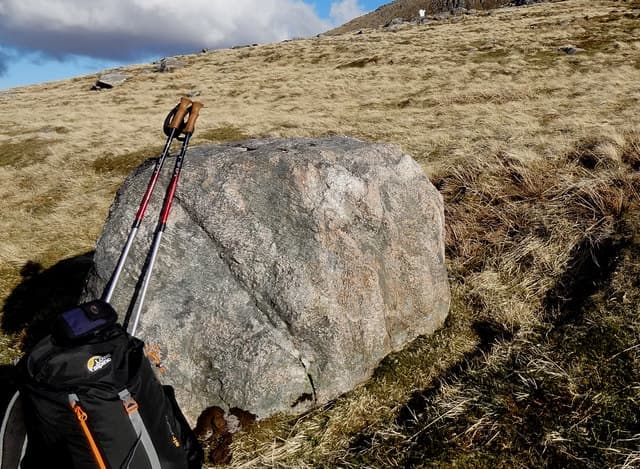
Corbett · Knoydart
Sgurr Mhurlagain
Sgùrr Mhurlagain is the steep-sided Corbett rising directly above the head of Loch Arkaig — visible at the end of the long drive west from Fort William and reached from the road end at Strathan. The mountain is small in distance terms but big in gradient: the south ridge is a continuous steep grass-and-rock slope from loch level to summit with little respite. The reward is a remote feeling out of proportion to the unassuming height, and views across Glen Pean to Sgurr Thuilm and the heart of Knoydart.
Quick facts
- Height
- 880m/ 2887ft
- Prominence
- 515 m
- Distance
- ~9 km
- Ascent
- ~880 m
- Time
- 3–5 hrs
- Grid ref
- NN012944
- Parking
- NM987916
- Nearest city
- Fort William· 22km
- Dogs
- Dogs on lead required near livestockDog-friendly guide ↗
Height and prominence cross-checked against the Database of British and Irish Hills (CC BY).
No GPX track yet
Walked this route? Share your track to help other walkers.
Standard route
loch-side track 25% · deep heather 40% · grassy upper slopes 25% · summit area 10%
Park at Strathan at the western end of the Loch Arkaig road. Walk a short distance up Glen Dessarry on the estate track, then turn south up steep grassy slopes onto the south ridge of Sgùrr Mhurlagain. The ridge climbs more or less straight to the summit cairn with no easy gradient anywhere. Descent reverses the line. A genuine 5-hour day despite the modest mileage on the map.
Terrain
Short and unrelentingly steep. The south ridge is grass and heather with rock outcrops; in wet conditions the grass on the upper section is slippery on descent. No path of any consequence — pick your line. The summit is a small grassy crown with a modest cairn.
In winter
In winter Sgùrr Mhurlagain's steepness becomes the defining feature. Hard snow on the south ridge requires confident axe-and-crampon work; soft snow turns the descent into a long sit-and-slide problem. Avalanche-prone in heavily loaded conditions. Sensible only when the ridge is consolidated.
Kit for this: the winter Munro kit list · which boots take crampons
Best time of year
Getting there
- Glasgow3h 0m
- Edinburgh3h 19m
OS maps: OS Landranger 33
Mobile signal: No usable signal at Strathan or on the hill — the head of Loch Arkaig is among the more isolated road-ends in Lochaber
Current conditions
Daylight Today
- Sunrise
- 07:51
- Sunset
- 18:23
- Civil dawn
- 07:13
- Civil dusk
- 19:02
NOAA Solar Calculator · 14 October 2026
Pair with
Curated multi-hill combinations from Sgurr Mhurlagain.
Around Sgurr Mhurlagain on the SCOT network
Getting there, basing yourself, and what to do off the hill.
Getting there: Glenfinnan station
Glenfinnan Viaduct; Streap, Sgurr Thuilm, Glen Finnan Munros
17km from the hill
tripscot.co.uk
On TripSCOTBase yourself in Fort William
Ben Nevis base, West Highland Line, gateway to Lochaber
22km from the hill
tripscot.co.uk
On TasteSCOTAfter the hill: Ben Nevis Distillery
Fort William — Lochaber distillery at the foot of the Ben; long-aged Japanese-owned classics
21km from the hill
tastescot.co.uk
Sgurr Mhurlagain — common questions
- How difficult is Sgurr Mhurlagain?
- Sgurr Mhurlagain carries a 3/5 (moderately challenging) grade on the OutdoorSCOT scale. Count on about 9km, 880m of ascent and a 3-5 hour day on the standard route. Terrain: Short and unrelentingly steep.
- How prominent is Sgurr Mhurlagain?
- Sgurr Mhurlagain has 515m of topographic prominence — the height of its summit above the highest col connecting it to higher ground.
- Where should I park to climb Sgurr Mhurlagain?
- Standard parking is at NM987916. Check the parking grid reference on an OS map before travel; informal laybys can fill on summer weekends.
- When should I climb Sgurr Mhurlagain?
- The standard good-weather months for Sgurr Mhurlagain are May, June, July, August, September, October. Outside those months, expect winter conditions on the high ground — full mountain kit, navigation skills, and a check of the SAIS avalanche forecast for the relevant region.
- Can I bring my dog up Sgurr Mhurlagain?
- On a lead only — the route crosses ground with livestock or nesting-bird interest.
- What's mobile reception like on Sgurr Mhurlagain?
- No usable signal at Strathan or on the hill — the head of Loch Arkaig is among the more isolated road-ends in Lochaber
- Is Sgurr Mhurlagain safe in winter?
- In winter Sgùrr Mhurlagain's steepness becomes the defining feature. Hard snow on the south ridge requires confident axe-and-crampon work; soft snow turns the descent into a long sit-and-slide problem. Avalanche-prone in heavily loaded conditions. Sensible only when the ridge is consolidated.
Get the OutdoorSCOT weekly
One email a week — new route, hill and bothy guides, seasonal conditions and the odd hard-won lesson. No spam, unsubscribe in one click.