Glen
Glen Strathfarrar
Scotland's most restricted glen — a locked gate at Struy limits car access to specific hours, which has inadvertently preserved native pinewoods and four excellent Munros almost no one visits.
- Munros
- 4
- Corbetts
- 2
- Grahams
- 2
- Highest peak
- Sgurr a' Choire Ghlais (1083.7m)
Glen Strathfarrar has a locked gate. Culligran Estate controls vehicle access through a gate at Struy: it is open Monday to Saturday during daylight hours (roughly 9am–6pm in summer), closed on Wednesday mornings for estate management, and shut on Sundays. You do not need a permit or a booking — you arrive during the open window, drive through, and must be back at the gate before it closes. If you are on foot or bicycle, the pedestrian gate is accessible at any time without restriction.
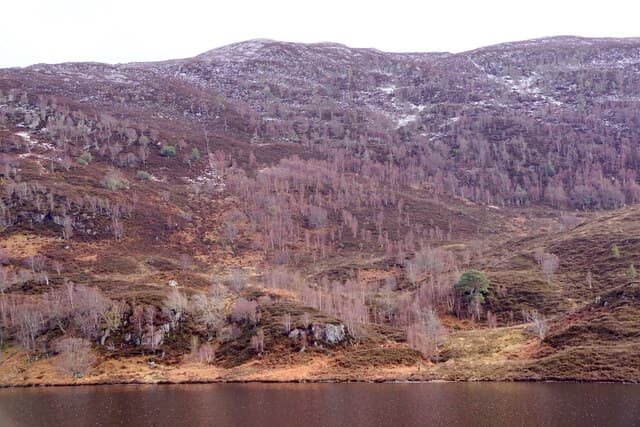
Beyond the gate the glen road runs 22km through the River Farrar valley to the Monar dam — one of the longest gated estate roads in the Highlands. The lower glen has remnant native pinewoods: old-growth Scots pine that survived clearance precisely because the restricted access discouraged the kind of grazing pressure that eliminated pinewood elsewhere. The four Munros above the south side of the glen (Sgurr na Ruaidhe, Carn nan Gobhar, Sgurr a' Choire Ghlais, Sgurr Fhuar-thuill) form a continuous ridge of genuine quality, collectively among the least-visited in the northern Highlands given their accessibility once inside the gate.
The gate hours change seasonally — November to April hours are shorter and less predictable. Check Culligran Estate's current schedule before travelling, particularly for autumn and spring visits where the gate may close as early as 4pm.
The road in
End of road
The road runs 22km beyond the gate to the Monar dam. Beyond the dam is Loch Monar reservoir and foot-only terrain. The dam area has rough parking for those who have driven through.
Parking2 spots
Struy gate layby
8 cars
Free
Layby outside the gate at Struy for walkers and cyclists arriving on foot or by bike. Vehicle access through the gate is open Mon–Sat during permitted hours only.
Monar dam rough parking
10 cars
Free
Rough gravel area at the dam end of the glen road — the main start point for the Strathfarrar Munro ridge. Only accessible to vehicles that have passed through the Struy gate during permitted hours.
Hills from Glen Strathfarrar4 Munros · 2 Corbetts · 2 Grahams
Carn Gorm
677.3m
Sgorr na Diollaid
817.9m
Sgurr na Ruaidhe
993m
Carn nan Gobhar
992m
Sgurr a' Choire Ghlais
1083.7m
Beinn a' Bhathaich Ard (Beinn a' Bha' ach Ard)
862m
Carn Loch na Gobhlaig
716m
Beinn na Muice
693.8m
Sgurr Fhuar-thuill
1049.2m
Carn nam Bad
458.1m
Gravel cycling1 route nearby
What's in the glen
Native pinewoods
The lower glen retains some of the more intact remnant Caledonian pinewoods in the northern Highlands — old-growth Scots pine with natural regeneration, a result of the restricted access keeping grazing pressure low. The woodland is an SSSI. Walk through slowly on the way back from the dam; most people drive past without stopping.
Strathfarrar Munro ridge
The four Munros above the south side of the glen — Sgurr na Ruaidhe (993m), Carn nan Gobhar (992m), Sgurr a' Choire Ghlais (1083m) and Sgurr Fhuar-thuill (1049m) — form a continuous ridge accessed from the Monar dam car park. The round is 18km with 1,400m of ascent and is rarely crowded. These are quality hills that see a fraction of the footfall their elevation and character would attract if the glen were open.
Loch Monar
A remote reservoir at the glen head, extended by the Monar dam as part of the Affric-Beauly hydro scheme. The dam road end is the furthest vehicular point in the glen — beyond is foot-only terrain in some of the most remote country in the northern Highlands.
River Farrar
Our take
The gate is the best thing that ever happened to Strathfarrar. It means the Munro ridge — which is genuinely good, better than its obscurity suggests — has a fraction of the footfall of equivalent hills in Affric or Kintail. Plan your day around the access hours (check Culligran Estate before you go, not NatureScot), arrive early enough to reach the dam area before committing to the ridge, and be back at the gate with time to spare. The pinewoods in the lower glen are worth walking through slowly on the way out.
History
The Strathfarrar gate predates formal conservation designations — it originated as an estate access restriction to protect sporting interests and limit disturbance during stalking season. When the glen was designated a Site of Special Scientific Interest in recognition of its native pinewoods and river habitats, the controlled access arrangement was retained under a management agreement between Culligran Estate and conservation bodies. The result was that a restriction initially serving estate purposes became, over time, an effective conservation measure.
The native pinewoods of the lower glen are among the more intact remnant Caledonian woodlands in the northern Highlands. Their survival is partly attributable to the gate: the limited visitor numbers have reduced the grazing pressure and human disturbance that degraded pinewood elsewhere. The estate actively manages the deer population to allow natural regeneration in the pinewood sections. This is an unusual case where an estate access restriction and conservation outcomes have aligned rather than conflicted.
Practical
- Mobile signal
- No signal beyond Struy.
- Midges
- High(4/5)
- Public transport
- None. The gate requires a permit — no bus access.
- Dogs
- On lead — livestock or ground-nesting birds present.
Map
Hills (green), bothies (brown), parking (blue), wild swimming (light blue).
Track your Glen Strathfarrar Munros
Log your completions and plan your next route.
Open Hill Tracker →Nearby glens
Scotland outdoor updates
Route guides, condition reports and seasonal picks — once a month, no noise.
Glen Strathfarrar — common questions
- How's the drive into Glen Strathfarrar?
- Private_gated. The road runs 22km beyond the gate to the Monar dam. Beyond the dam is Loch Monar reservoir and foot-only terrain. The dam area has rough parking for those who have driven through.
- Can you drive a campervan into Glen Strathfarrar?
- Best avoided in a big vehicle. Narrow sections, tight turns or scarce passing space make Glen Strathfarrar awkward for motorhomes and large campervans — park in a wider valley and walk in.
- Will midges be a problem in Glen Strathfarrar?
- We rate Glen Strathfarrar 4/5 for midges — severe between late May and September. Still, humid evenings are peak biting time; wind and height are your friends. Pack Smidge and a head net from May.
- Is it legal to wild camp in Glen Strathfarrar?
- Yes. Under the Land Reform Act 2003 you can wild camp on most unenclosed land in Scotland, provided you follow the Scottish Outdoor Access Code — keep off enclosed farmland, camp in small groups, and leave no trace. Glen Strathfarrar sits outside the Loch Lomond and Trossachs Camping Management Zones, so the March-September permit restrictions there don't apply here.
- How do I reach Glen Strathfarrar by public transport?
- None. The gate requires a permit — no bus access.