Marilyn · Orkney & Shetland
Noss Head
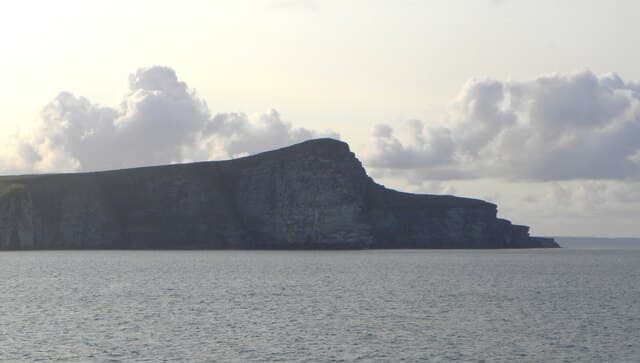
The Noup of Noss is the summit of the small uninhabited island of Noss, a National Nature Reserve famous for its gannet colony. At 181m the cliff-top is among the great seabird spectacles in Europe, with the sandstone wall dropping sheer to a sea filled with diving birds.
Quick facts
- Height
- 181m/ 594ft
- Prominence
- 181 m
- Grid ref
- HU 55382 39871
- Dogs
- Dogs on lead required near livestockDog-friendly guide ↗
Height and prominence cross-checked against the Database of British and Irish Hills (CC BY).
No GPX track yet
Walked this route? Share your track to help other walkers.
Standard route
grass moorland 55% · coastal cliffs 30% · heather patches 15%
After the seasonal inflatable crossing from Bressay, a circular walk follows the cliff edge anticlockwise round the island to the Noup and back. The route is a simple wardened circuit on close-cropped sheep turf.
Terrain
Short maritime turf grazed by Shetland sheep, with the spectacular sandstone cliffs of the Noup forming the final pull. Keep well back from the edges in any wind.
In winter
Noss is closed in winter — the reserve and the boat operate only from late April to August. Outside that window access is by special permission and the ferry rarely runs.
Best time of year
Getting there
- Glasgow14h 54m
- Edinburgh12h 14m
Ferry access
Aberdeen → Lerwick (Shetland)
- Crossing time720 min
- Summer sailingsDaily overnight sailing (Apr–Oct)
- Winter sailingsDaily overnight sailing (Nov–Mar)
- Book ahead14 days
A 12-hour overnight sailing — book a cabin berth. Plan a multi-day Shetland trip; the island is large and the journey is substantial. Flights from Aberdeen/Edinburgh are a faster alternative.
Book on ferry operator ↗OS maps: OS Landranger 4, OS Explorer 466N
Mobile signal: Poor. Remote Noss island, Shetland; no reliable coverage.
Current conditions
Daylight Today
- Sunrise
- 06:29
- Sunset
- 19:31
- Civil dawn
- 05:46
- Civil dusk
- 20:14
NOAA Solar Calculator · 14 September 2026
Noss Head — common questions
- How difficult is Noss Head?
- Noss Head carries a 1/5 (easy) grade on the OutdoorSCOT scale. Ground conditions: Short maritime turf grazed by Shetland sheep, with the spectacular sandstone cliffs of the Noup forming the final pull.
- How much drop does Noss Head have?
- Noss Head's prominence is its full height — 181m — because it is the highest point of its landmass, with no higher ground connected to it. Passing the 150m-drop threshold on all sides is exactly what makes it a Marilyn.
- What's the best month to climb Noss Head?
- Aim for March, April, May, June, July, August, September, October on Noss Head. In the remaining months treat it as a winter hill — full kit, solid navigation, and a look at the relevant SAIS avalanche forecast before you go.
- Can dogs go up Noss Head?
- Dogs are fine on a lead. The route passes livestock or ground-nesting bird habitat, so keep them close throughout.
- Will I get phone signal on Noss Head?
- Poor. Remote Noss island, Shetland; no reliable coverage.
- How do I get the ferry to Noss Head?
- Aberdeen → Lerwick (Shetland). Daily overnight sailing (Apr–Oct) in summer; Daily overnight sailing (Nov–Mar) in winter. Book at least 14 days ahead. A 12-hour overnight sailing — book a cabin berth. Plan a multi-day Shetland trip; the island is large and the journey is substantial. Flights from Aberdeen/Edinburgh are a faster alternative.
- Is Noss Head safe in winter?
- Noss is closed in winter — the reserve and the boat operate only from late April to August. Outside that window access is by special permission and the ferry rarely runs.
Get the OutdoorSCOT weekly
One email a week — new route, hill and bothy guides, seasonal conditions and the odd hard-won lesson. No spam, unsubscribe in one click.