Marilyn · Argyll & Bute
Beinn Ghlas
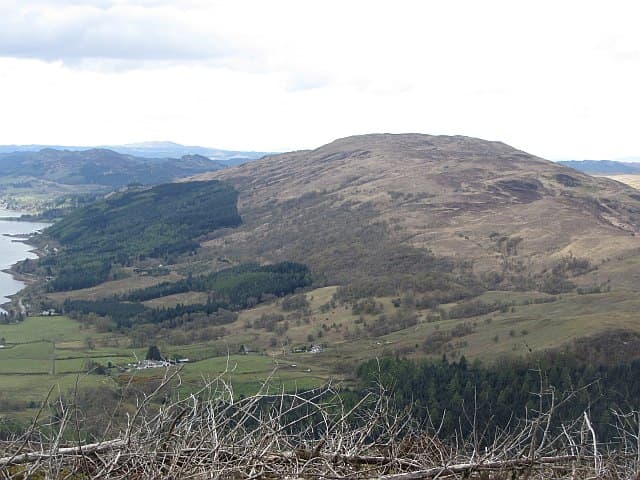
This lower Beinn Ghlas (Green-grey Hill) is the 420m high point of the long Kintyre ridge above Tarbert. From its crown you see Arran rising across Kilbrannan Sound and, on clear days, Antrim across the North Channel.
Gaelic: “mountain, grey-green” · Pronunciation: bine glass
Quick facts
- Height
- 420m/ 1378ft
- Prominence
- 197 m
- Grid ref
- NR 98930 99275
- Nearest city
- Oban· 33km
- Dogs
- Dogs on lead required near livestockDog-friendly guide ↗
Height and prominence cross-checked against the Database of British and Irish Hills (CC BY).
No GPX track yet
Walked this route? Share your track to help other walkers.
Standard route
heather moorland 55% · grass slopes 30% · rocky summit 15%
A favourite line begins at Tarbert and follows farm tracks up onto the ridge, then a heather-and-grass crest north-east to the summit. Around 3 hours sees you up and back if conditions are dry.
Terrain
A pleasing mix of farm track, sheep-cropped grass and short heather. The ridge is broad enough to be safe in most conditions but narrow enough to keep direction obvious.
In winter
Mild Atlantic conditions are normal but rime ice forms on the trig pillar and ridge fenceposts in cold snaps. The exposed crest catches every gale that blows up the Kintyre peninsula.
Kit for this: the winter Munro kit list · which boots take crampons
Best time of year
Getting there
- Glasgow3h 39m
- Edinburgh5h 19m
OS maps: OS Landranger 55, OS Explorer 360S
Mobile signal: Moderate. Kintyre; reasonable coverage on eastern side.
Current conditions
Daylight Today
- Sunrise
- 07:15
- Sunset
- 19:09
- Civil dawn
- 06:38
- Civil dusk
- 19:46
NOAA Solar Calculator · 27 September 2026
Around Beinn Ghlas on the SCOT network
Getting there, basing yourself, and what to do off the hill.
Beinn Ghlas — common questions
- Is Beinn Ghlas a hard climb?
- Beinn Ghlas is rated 1/5 (easy) on the OutdoorSCOT scale. Ground conditions: A pleasing mix of farm track, sheep-cropped grass and short heather.
- How much drop does Beinn Ghlas have?
- The drop is 197m: measured from the summit of Beinn Ghlas down to the saddle joining it to higher terrain. Passing the 150m-drop threshold on all sides is exactly what makes it a Marilyn.
- What's the best month to climb Beinn Ghlas?
- Aim for March, April, May, June, July, August, September, October on Beinn Ghlas. In the remaining months treat it as a winter hill — full kit, solid navigation, and a look at the relevant SAIS avalanche forecast before you go.
- Can dogs go up Beinn Ghlas?
- Dogs are fine on a lead. The route passes livestock or ground-nesting bird habitat, so keep them close throughout.
- Will I get phone signal on Beinn Ghlas?
- Moderate. Kintyre; reasonable coverage on eastern side.
- Is Beinn Ghlas safe in winter?
- Mild Atlantic conditions are normal but rime ice forms on the trig pillar and ridge fenceposts in cold snaps. The exposed crest catches every gale that blows up the Kintyre peninsula.
Get the OutdoorSCOT weekly
One email a week — new route, hill and bothy guides, seasonal conditions and the odd hard-won lesson. No spam, unsubscribe in one click.