Corbett · North-West Highlands
Ruadh-stac Beag
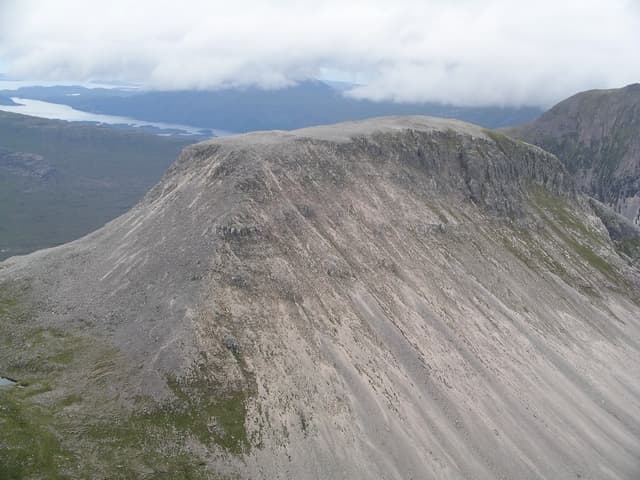
Ruadh-stac Beag is the detached northern outlier of the Beinn Eighe massif — a steep, blocky quartzite cone that sits apart from the main Munro ridge across the wild upper bowl of Coire Mhic Fhearchair. At 896m it is the only Corbett in the Beinn Eighe range and is generally tackled as a stand-alone day rather than tagged on to the Munro round, because the descent into and re-ascent from the col is substantial. The summit gives one of the finest views in Torridon: straight across the upper corrie to the Triple Buttress of Coinneach Mhor.
Gaelic: “red, small” · Pronunciation: roo-ah stac bek
Quick facts
- Height
- 896m/ 2940ft
- Prominence
- 181 m
- Distance
- ~16 km
- Ascent
- ~788 m
- Time
- 6–9 hrs
- Grid ref
- NG972613
- Parking
- NG958568
- Nearest
- Ullapool· Inverness 71km
- Dogs
- Dogs on lead required near livestockDog-friendly guide ↗
Height and prominence cross-checked against the Database of British and Irish Hills (CC BY).
No GPX track yet
Walked this route? Share your track to help other walkers.
Standard route
stalkers path 35% · corrie path 15% · quartzite scree 40% · summit cone 10%
Walk in from the Coire Dubh Mor car park on the A896 along the well-built stalkers path that traverses between Liathach and Beinn Eighe, then divert north into Coire Mhic Fhearchair on the path past the small lochan. From the high lochan, leave the path and climb the rough south-east shoulder of Ruadh-stac Beag direct — pathless quartzite scree and slabby steps. Around 16km return with 788m of ascent. The summit cone is loose underfoot; descend by the same line.
Terrain
The Coire Dubh stalkers path is firm and well drained as far as the Coire Mhic Fhearchair junction. Beyond, the ground is loose Cambrian quartzite — angular blocks, scree-filled gullies and slabby outcrops where the rock is wet and slippery. There is no path on the hill itself and the south-east shoulder route involves a short steep pull on big quartzite blocks just below the summit.
In winter
Coire Mhic Fhearchair is famous for early-season ice and the Triple Buttress holds a winter atmosphere into May. Ruadh-stac Beag itself is not a climbing objective in winter but the south-east shoulder becomes a proper mountaineering line under snow and ice — axe and crampons mandatory, and avalanche risk on the upper bowl after big westerly loading. Expect a long day with limited daylight from November to February.
Kit for this: the winter Munro kit list · which boots take crampons
This hill is in the Torridon SAIS forecast area. Check SAIS forecasts in winter (December–April).
Best time of year
Getting there
- Glasgow4h 57m
- Edinburgh4h 22m
OS maps: OS Landranger 19
Mobile signal: No signal — Fisherfield wilderness, completely isolated
Current conditions
Daylight Today
- Sunrise
- 07:53
- Sunset
- 18:22
- Civil dawn
- 07:14
- Civil dusk
- 19:02
NOAA Solar Calculator · 14 October 2026
Pair with
Curated multi-hill combinations from Ruadh-stac Beag.
Around Ruadh-stac Beag on the SCOT network
Getting there, basing yourself, and what to do off the hill.
Ruadh-stac Beag — common questions
- How difficult is Ruadh-stac Beag?
- Ruadh-stac Beag carries a 5/5 (very challenging) grade on the OutdoorSCOT scale. Count on about 16km, 788m of ascent and a 6-9 hour day on the standard route. Terrain: The Coire Dubh stalkers path is firm and well drained as far as the Coire Mhic Fhearchair junction.
- How prominent is Ruadh-stac Beag?
- Ruadh-stac Beag has 181m of topographic prominence — the height of its summit above the highest col connecting it to higher ground.
- Where should I park to climb Ruadh-stac Beag?
- Standard parking is at NG958568 near Ullapool. Check the parking grid reference on an OS map before travel; informal laybys can fill on summer weekends.
- When should I climb Ruadh-stac Beag?
- The standard good-weather months for Ruadh-stac Beag are May, June, July, August, September. Outside those months, expect winter conditions on the high ground — full mountain kit, navigation skills, and a check of the SAIS avalanche forecast for the relevant region.
- Can I bring my dog up Ruadh-stac Beag?
- On a lead only — the route crosses ground with livestock or nesting-bird interest.
- What's mobile reception like on Ruadh-stac Beag?
- No signal — Fisherfield wilderness, completely isolated
- Is Ruadh-stac Beag safe in winter?
- Coire Mhic Fhearchair is famous for early-season ice and the Triple Buttress holds a winter atmosphere into May. Ruadh-stac Beag itself is not a climbing objective in winter but the south-east shoulder becomes a proper mountaineering line under snow and ice — axe and crampons mandatory, and avalanche risk on the upper bowl after big westerly loading. Expect a long day with limited daylight from November to February.
Get the OutdoorSCOT weekly
One email a week — new route, hill and bothy guides, seasonal conditions and the odd hard-won lesson. No spam, unsubscribe in one click.