Corbett · Far North
Arkle
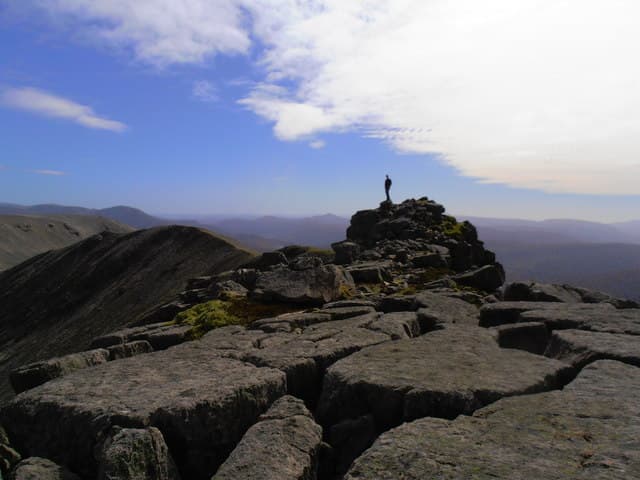
Arkle is Foinaven's quartzite twin — the more compact, more conical neighbour rising above Loch Stack deep in the Reay Forest. Where Foinaven sprawls along a three-kilometre ridge, Arkle is a single triangular mountain with bright pale slopes that gleam after rain and an unmistakeable profile from the south. The name has become a synonym for tough endurance in racing thanks to the legendary steeplechaser, and the hill earns the association — short on metres, long on character, and with terrain that punishes anyone in a hurry.
Quick facts
- Height
- 787m/ 2582ft
- Prominence
- 392 m
- Distance
- ~18 km
- Ascent
- ~920 m
- Time
- 5–8 hrs
- Grid ref
- NC302461
- Parking
- NC295394
- Nearest
- Ullapool
- Dogs
- Dogs on lead required near livestockDog-friendly guide ↗
Height and prominence cross-checked against the Database of British and Irish Hills (CC BY).
No GPX track yet
Walked this route? Share your track to help other walkers.
Standard route
loch-side path 20% · rough moorland 25% · quartzite terraces 40% · summit ridge 15%
The standard line starts at Achfary on the A838 by Loch More. Follow the estate road north-west past Lone, climbing into the lower glen for around 4km. Where the track ends near the Allt Horn, head north onto Arkle's south-east ridge. The route climbs steadily over quartzite blocks to the summit cairn. The simplest descent retraces the ascent line; an alternative drops south to Loch Stack for a circuit, though that involves a river crossing of the Allt Horn. Allow 6–7 hours.
Terrain
Good estate track for the first 4km, then trackless boggy ground onto the ridge. The upper mountain is built of polished white quartzite — large stable blocks that demand careful foot placement, and which become genuinely slippery in any wet conditions. The summit ridge is narrow with significant drops east into Coire Trillichie.
In winter
In winter Arkle is a serious far-north hill day. The quartzite ridge ices up readily and the descent line is committing in deep snow. With under seven usable hours of light through midwinter at 58° north, headtorches are essential at both ends of the day. In firm consolidated conditions it ranks as easily the finest small mountain days in Britain; in marginal weather, well left alone.
Kit for this: the winter Munro kit list · which boots take crampons
Best time of year
Getting there
- Glasgow5h 25m
- Edinburgh6h 32m
OS maps: OS Landranger 9
Mobile signal: No usable signal in the Reay Forest interior; brief EE/Vodafone on the A838 at Achfary
Current conditions
Daylight Today
- Sunrise
- 07:52
- Sunset
- 18:19
- Civil dawn
- 07:12
- Civil dusk
- 18:59
NOAA Solar Calculator · 14 October 2026
Pair with
Curated multi-hill combinations from Arkle.
Around Arkle on the SCOT network
Getting there, basing yourself, and what to do off the hill.
Arkle — common questions
- How hard is Arkle?
- We grade Arkle at 3/5, which puts it in moderately challenging territory. The usual route is around 18km with 920m of climbing; allow 5-8 hours. Underfoot: Good estate track for the first 4km, then trackless boggy ground onto the ridge.
- What is Arkle's prominence?
- 392m of prominence. That's the vertical drop from the summit to the col that links Arkle to the next higher ground.
- Where do I park for Arkle?
- Most walkers start from NC295394 near Ullapool. Verify the grid reference on an OS map before you set off — space is tight on busy summer weekends.
- When is the best time to climb Arkle?
- May, June, July, August, September give the most reliable conditions on Arkle. Beyond that window the high ground turns wintry: carry full mountain kit, be confident navigating, and check the SAIS avalanche forecast for the area.
- Is Arkle dog-friendly?
- Yes, but dogs must be kept on a lead — there is livestock or ground-nesting bird interest on the route.
- Is there mobile signal on Arkle?
- No usable signal in the Reay Forest interior; brief EE/Vodafone on the A838 at Achfary
- Is Arkle safe in winter?
- In winter Arkle is a serious far-north hill day. The quartzite ridge ices up readily and the descent line is committing in deep snow. With under seven usable hours of light through midwinter at 58° north, headtorches are essential at both ends of the day. In firm consolidated conditions it ranks as easily the finest small mountain days in Britain; in marginal weather, well left alone.
Get the OutdoorSCOT weekly
One email a week — new route, hill and bothy guides, seasonal conditions and the odd hard-won lesson. No spam, unsubscribe in one click.