Glen
Glen Banchor
Three Monadhliath Munros starting 1km from Newtonmore train station — the most genuinely car-free Munro day in the Cairngorms National Park.
- Munros
- 1
- Grahams
- 2
- Highest peak
- A' Chailleach (929.3m)
Glen Banchor opens northeast from Newtonmore directly into the Monadhliath hills — a minor road running 2km from the village before becoming a track above the River Calder. Newtonmore station is on the Perth–Inverness main line; the glen road starts a kilometre from the platform. Three Munros (A' Chailleach 930m, Carn Sgulain 920m, Carn Dearg 945m) are reachable in a long day from the station without a car, which makes Glen Banchor one of the few places in Scotland where a Munro round trip is genuinely possible by train.
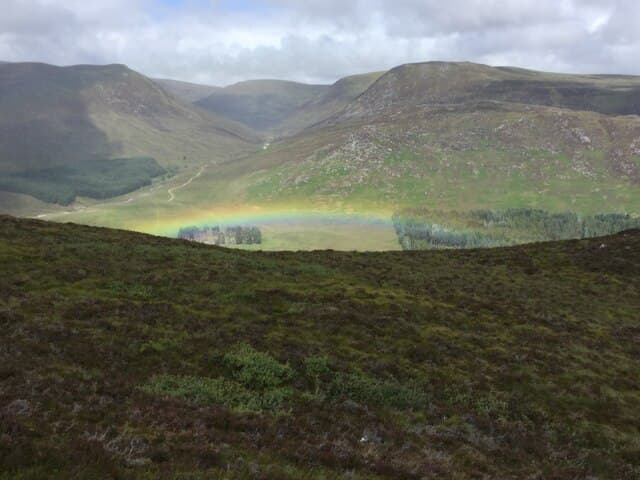
The Monadhliath is the range that Cairngorms visitors drive past to reach the Cairngorms. It runs northwest from the A9 across a vast rounded plateau — grassy, often boggy, lacking the rock architecture of the Cairngorm massif. Summits here do not attract crowds. The views from the plateau on clear days extend southeast across the Cairngorms and southwest toward the Drumochter hills. In poor visibility the featureless terrain makes navigation demanding.
In the lower glen, the ruins of the old Banchor church stand in a graveyard with carved medieval stones. The site name — Beannchar in Gaelic, meaning a peaked or pointed enclosure — is a recognised type-name for early Christian monastic settlements; Bangor in Wales and Ireland derive from the same root. The site almost certainly predates the medieval church structure visible today.
The road in
Single-track road etiquette
Pull into passing places to let oncoming vehicles pass. Don't park in passing places. If a faster vehicle is behind you, pull over and let them past. Do not reverse at speed — wait in a passing place.
End of road
The minor road becomes a track after 2km. The track continues into the upper glen toward the Monadhliath approaches — foot only beyond the road end.
Parking1 spot
Glen Banchor road end
6 cars
Free
Rough layby where the minor road becomes a track, 2km from Newtonmore. Main vehicle access point for Monadhliath approaches. Walkers from the train can walk the road from the station in under 30 minutes.
Hills from Glen Banchor1 Munros · 2 Grahams
What's in the glen
Old Banchor church
The ruins of the old Banchor church in the lower glen — a pre-Reformation site whose name (<em>Beannchar</em>, meaning peaked enclosure) is a recognised type-name for early Columban monastic settlements. The same root gives Bangor in Wales and Ireland. The graveyard contains medieval carved stones including some with interlaced knotwork. The church footprint is visible; the site was likely in use well before the medieval building that survives as ruins.
Monadhliath plateau
The Monadhliath plateau above Glen Banchor is vast, grassy and almost entirely unvisited. Three Munros (A' Chailleach 930m, Carn Sgulain 920m, Carn Dearg 945m) sit on the ridge above the glen. The summit views on clear days extend southeast across the full Cairngorm massif. Navigation on the featureless plateau demands care in poor visibility — there are few landmarks above the valley.
River Calder
Our take
Take the train to Newtonmore and walk Glen Banchor. The round to A' Chailleach and Carn Sgulain is 22km with 900m of ascent — a long day, but the start and end are 1km from the station rather than 40km of driving from Inverness. The Monadhliath Munros will not give you the drama of Liathach or the Cuillin, but they will give you a plateau largely to yourself and the specific satisfaction of a hill day done without a car. Look for the church ruin and graveyard in the lower glen on the way in — it takes five minutes and it is worth it.
History
Glen Banchor is in the heart of Badenoch — the territory of the Clan Macpherson, whose seat at Cluny Castle lies a few kilometres to the west above the River Spey. The Macphersons were out in the '45 under Ewen Macpherson of Cluny, and after Culloden (1746) Cluny became one of the most wanted men in Britain. He spent nine years hiding in the hills and glens around Badenoch — including a period in a concealed shelter known as "Cluny's Cage" on Ben Alder — while the government searched for him and his estate was forfeited. He was finally smuggled to France in 1755 without ever being captured. The landscape of Glen Banchor and the surrounding hills was the terrain in which this prolonged concealment took place.
The Banchor church site has early Christian origins. The name Beannchar (peaked or pointed enclosure) was used for early monastic settlements of the Columban tradition across Scotland and Ireland; the same root gives Bangor in Wales (Bangors Fawr and Iscoed) and Bangor in County Down, both major early Christian sites. A church here is documented from the medieval period; the site is likely older. The carved stones in the graveyard span several centuries and include some with interlaced knotwork patterns associated with the early medieval period.
Practical
- Mobile signal
- Signal in Newtonmore. No signal in the upper glen or on the Monadhliath plateau.
- Midges
- Moderate(3/5)
- Public transport
- Newtonmore is on the Perth–Inverness main line (ScotRail). The glen road starts 1km from the station — a genuine car-free Munro day.
- Dogs
- On lead — livestock or ground-nesting birds present.
Map
Hills (green), bothies (brown), parking (blue), wild swimming (light blue).
Nearby glens
Scotland outdoor updates
Route guides, condition reports and seasonal picks — once a month, no noise.
Glen Banchor — common questions
- How's the drive into Glen Banchor?
- Single-track with passing places. The minor road becomes a track after 2km. The track continues into the upper glen toward the Monadhliath approaches — foot only beyond the road end.
- Can you drive a campervan into Glen Banchor?
- Best avoided in a big vehicle. Narrow sections, tight turns or scarce passing space make Glen Banchor awkward for motorhomes and large campervans — park in a wider valley and walk in.
- Will midges be a problem in Glen Banchor?
- We rate Glen Banchor 3/5 for midges — significant between late May and September. Still, humid evenings are peak biting time; wind and height are your friends. Pack Smidge and a head net from May.
- Is it legal to wild camp in Glen Banchor?
- Yes. Under the Land Reform Act 2003 you can wild camp on most unenclosed land in Scotland, provided you follow the Scottish Outdoor Access Code — keep off enclosed farmland, camp in small groups, and leave no trace. Glen Banchor sits outside the Loch Lomond and Trossachs Camping Management Zones, so the March-September permit restrictions there don't apply here.
- How do I reach Glen Banchor by public transport?
- Newtonmore is on the Perth–Inverness main line (ScotRail). The glen road starts 1km from the station — a genuine car-free Munro day.