Marilyn · Argyll & Bute
Glas Bheinn
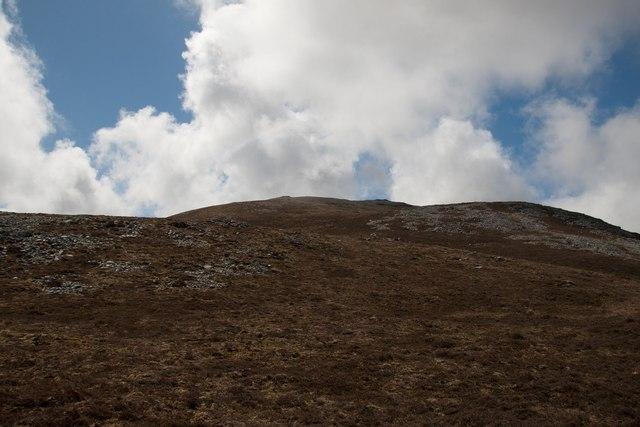
Glas Bheinn on Islay is the close neighbour of Beinn Bheigier — a 472m hill on the same wild eastern moorland. Its limestone-influenced geology gives surprisingly green, drained turf in contrast to the boggy approach.
Gaelic: “grey-green” · Pronunciation: glass bheinn
Quick facts
- Height
- 472m/ 1549ft
- Prominence
- 208 m
- Grid ref
- NR 42977 59196
- Dogs
- Dogs on lead required near livestockDog-friendly guide ↗
Height and prominence cross-checked against the Database of British and Irish Hills (CC BY).
No GPX track yet
Walked this route? Share your track to help other walkers.
Standard route
limestone grassland 40% · heather moorland 40% · rocky outcrops 20%
Often combined with Beinn Bheigier from Ardtalla, taking the ridge link between the two summits. As a stand-alone ascent allow 3-4 hours. There is no path either way.
Terrain
Surprisingly well-drained turf on the upper slopes thanks to the limestone bedrock. The approach moor is wetter and tussockier.
In winter
Snow is unusual on Islay. The bigger risk is high wind on the exposed upper ridge — gales of 60mph are not unusual in winter and make the summit untenable.
Kit for this: the winter Munro kit list · which boots take crampons
Best time of year
Getting there
- Glasgow5h 47m
- Edinburgh8h 32m
Ferry access
Kennacraig → Port Askaig (Port Ellen closed for rebuilding until 2029)
- Crossing time115 min
- Summer sailingsCheck the CalMac summer timetable
- Winter sailings3–5 sailings a day each way (winter 2026/27 timetable)
- Last ferry backWinter 2026/27: last sailing from Port Askaig between 17:25 and 18:05, depending on the day
OS maps: OS Landranger 60, OS Explorer 352
Mobile signal: Moderate. Islay; EE reliable near Bowmore.
Current conditions
Daylight Today
- Sunrise
- 07:42
- Sunset
- 16:34
- Civil dawn
- 07:02
- Civil dusk
- 17:14
NOAA Solar Calculator · 7 November 2026
Around Glas Bheinn on the SCOT network
Getting there, basing yourself, and what to do off the hill.
Glas Bheinn — common questions
- How hard is Glas Bheinn?
- We grade Glas Bheinn at 1/5, which puts it in easy territory. Underfoot: Surprisingly well-drained turf on the upper slopes thanks to the limestone bedrock.
- What is Glas Bheinn's prominence?
- 208m of prominence. That's the vertical drop from the summit to the col that links Glas Bheinn to the next higher ground. That drop is what qualifies it as a Marilyn — a hill with at least 150m of descent on every side.
- When is the best time to climb Glas Bheinn?
- March, April, May, June, July, August, September, October give the most reliable conditions on Glas Bheinn. Beyond that window the high ground turns wintry: carry full mountain kit, be confident navigating, and check the SAIS avalanche forecast for the area.
- Is Glas Bheinn dog-friendly?
- Yes, but dogs must be kept on a lead — there is livestock or ground-nesting bird interest on the route.
- Is there mobile signal on Glas Bheinn?
- Moderate. Islay; EE reliable near Bowmore.
- How do I get the ferry to Glas Bheinn?
- Kennacraig → Port Askaig (Port Ellen closed for rebuilding until 2029). Check the CalMac summer timetable in summer; 3–5 sailings a day each way (winter 2026/27 timetable) in winter.
- Is Glas Bheinn safe in winter?
- Snow is unusual on Islay. The bigger risk is high wind on the exposed upper ridge — gales of 60mph are not unusual in winter and make the summit untenable.
Get the OutdoorSCOT weekly
One email a week — new route, hill and bothy guides, seasonal conditions and the odd hard-won lesson. No spam, unsubscribe in one click.