Marilyn · Orkney & Shetland
White Grunafirth
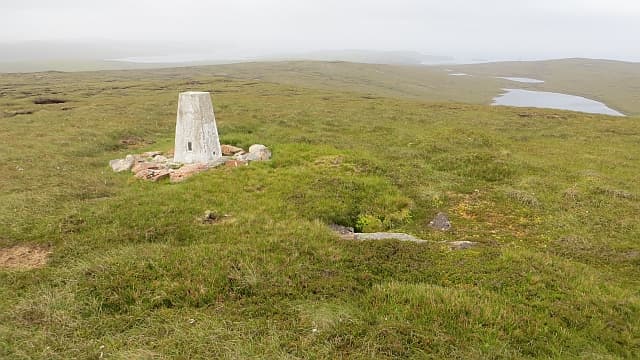
White Grunafirth sits in the north-west of the Shetland Mainland, above the head of Gruna Voe and within walking distance of the dramatic Eshaness coast. The 173m summit is a quiet peat dome that gives a fine close-up of the cliffs and stacks of the Northmaven peninsula.
Quick facts
- Height
- 173m/ 568ft
- Prominence
- 155 m
- Grid ref
- HU 27562 80727
- Dogs
- Dogs on lead required near livestockDog-friendly guide ↗
Height and prominence cross-checked against the Database of British and Irish Hills (CC BY).
No GPX track yet
Walked this route? Share your track to help other walkers.
Standard route
blanket bog 55% · heather moorland 30% · rocky summit 15%
Park on the lane near Heylor or Sullom and head north-west over rough moorland to the broad summit. Pathless throughout but the open ground gives plenty of visibility on a clear day.
Terrain
Wet peat moor with belts of heather and the occasional rocky knoll. The ground is wetter than it looks from the road; expect to detour around the deepest hags.
In winter
Storms straight off the Atlantic batter Northmaven all winter; snow rare but spindrift, hail and salt are constant companions. Daylight is short and tracks turn to mire.
Best time of year
Getting there
- Glasgow14h 59m
- Edinburgh13h 35m
Ferry access
Aberdeen → Lerwick (Shetland)
- Crossing time720 min
- Summer sailingsDaily overnight sailing (Apr–Oct)
- Winter sailingsDaily overnight sailing (Nov–Mar)
- Book ahead14 days
A 12-hour overnight sailing — book a cabin berth. Plan a multi-day Shetland trip; the island is large and the journey is substantial. Flights from Aberdeen/Edinburgh are a faster alternative.
Book on ferry operator ↗OS maps: OS Landranger 3, OS Explorer 469N
Mobile signal: Poor. Every network fails on this Shetland summit.
Current conditions
Daylight Today
- Sunrise
- 06:30
- Sunset
- 19:33
- Civil dawn
- 05:47
- Civil dusk
- 20:17
NOAA Solar Calculator · 14 September 2026
White Grunafirth — common questions
- What difficulty is White Grunafirth?
- On the OutdoorSCOT scale, White Grunafirth comes in at 1/5 — easy. Ground conditions: Wet peat moor with belts of heather and the occasional rocky knoll.
- How much drop does White Grunafirth have?
- The drop is 155m: measured from the summit of White Grunafirth down to the saddle joining it to higher terrain. Passing the 150m-drop threshold on all sides is exactly what makes it a Marilyn.
- What's the best month to climb White Grunafirth?
- Aim for March, April, May, June, July, August, September, October on White Grunafirth. In the remaining months treat it as a winter hill — full kit, solid navigation, and a look at the relevant SAIS avalanche forecast before you go.
- Can dogs go up White Grunafirth?
- Dogs are fine on a lead. The route passes livestock or ground-nesting bird habitat, so keep them close throughout.
- Will I get phone signal on White Grunafirth?
- Poor. Every network fails on this Shetland summit.
- How do I get the ferry to White Grunafirth?
- Aberdeen → Lerwick (Shetland). Daily overnight sailing (Apr–Oct) in summer; Daily overnight sailing (Nov–Mar) in winter. Book at least 14 days ahead. A 12-hour overnight sailing — book a cabin berth. Plan a multi-day Shetland trip; the island is large and the journey is substantial. Flights from Aberdeen/Edinburgh are a faster alternative.
- Is White Grunafirth safe in winter?
- Storms straight off the Atlantic batter Northmaven all winter; snow rare but spindrift, hail and salt are constant companions. Daylight is short and tracks turn to mire.
Get the OutdoorSCOT weekly
One email a week — new route, hill and bothy guides, seasonal conditions and the odd hard-won lesson. No spam, unsubscribe in one click.