Marilyn · Orkney & Shetland
Ronas Hill
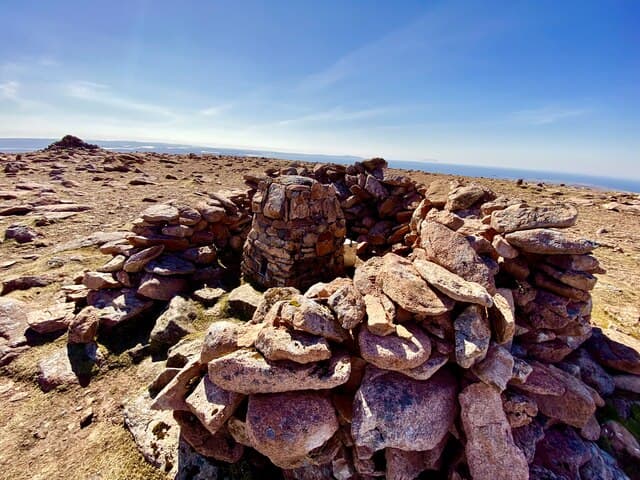
Ronas Hill is the highest point of Shetland at 450m, a great red-granite dome rising above the moors of northwest Mainland. The summit feels genuinely Arctic, with stone-stripe patterning, fellfield vegetation and one of the most northerly NTS-cared-for chambered cairns in Britain.
Quick facts
- Height
- 450m/ 1476ft
- Prominence
- 450 m
- Grid ref
- HU 30503 83477
- Dogs
- Dogs on lead required near livestockDog-friendly guide ↗
Height and prominence cross-checked against the Database of British and Irish Hills (CC BY).
No GPX track yet
Walked this route? Share your track to help other walkers.
Standard route
blanket bog 50% · rocky summit 30% · heather moorland 20%
From the masts at Collafirth Hill (reached by a tarmac service road) the walk follows pathless open moor west and north over Mid Field and Roga Field to the summit. Around 8km return with 200m net ascent in 3-4 hours — straightforward in clear weather only.
Terrain
Granite gravel and fellfield on the upper hill, peat hags and bog cotton lower down. The ground is comparatively dry by Shetland standards but featureless and rocky in places.
In winter
Snow can lie surprisingly long given the latitude. The exposure to Atlantic gales is the bigger hazard — winds over 70mph are routine in winter. Save for calm spells.
Best time of year
Getting there
- Glasgow14h 7m
- Edinburgh13h 42m
Ferry access
Aberdeen → Lerwick (Shetland)
- Crossing time720 min
- Summer sailingsDaily overnight sailing (Apr–Oct)
- Winter sailingsDaily overnight sailing (Nov–Mar)
- Book ahead14 days
A 12-hour overnight sailing — book a cabin berth. Plan a multi-day Shetland trip; the island is large and the journey is substantial. Flights from Aberdeen/Edinburgh are a faster alternative.
Book on ferry operator ↗OS maps: OS Landranger 1, OS Landranger 3, OS Explorer 469N
Mobile signal: Poor. Remote north Shetland mainland; limited coverage.
Current conditions
Daylight Today
- Sunrise
- 06:30
- Sunset
- 19:33
- Civil dawn
- 05:47
- Civil dusk
- 20:16
NOAA Solar Calculator · 14 September 2026
Ronas Hill — common questions
- Is Ronas Hill a hard climb?
- Ronas Hill is rated 3/5 (moderately challenging) on the OutdoorSCOT scale. Underfoot: Granite gravel and fellfield on the upper hill, peat hags and bog cotton lower down.
- What is Ronas Hill's prominence?
- Ronas Hill's prominence is its full height — 450m — because it is the highest point of its landmass, with no higher ground connected to it. That drop is what qualifies it as a Marilyn — a hill with at least 150m of descent on every side.
- When is the best time to climb Ronas Hill?
- March, April, May, June, July, August, September, October give the most reliable conditions on Ronas Hill. Beyond that window the high ground turns wintry: carry full mountain kit, be confident navigating, and check the SAIS avalanche forecast for the area.
- Is Ronas Hill dog-friendly?
- Yes, but dogs must be kept on a lead — there is livestock or ground-nesting bird interest on the route.
- Is there mobile signal on Ronas Hill?
- Poor. Remote north Shetland mainland; limited coverage.
- How do I get the ferry to Ronas Hill?
- Aberdeen → Lerwick (Shetland). Daily overnight sailing (Apr–Oct) in summer; Daily overnight sailing (Nov–Mar) in winter. Book at least 14 days ahead. A 12-hour overnight sailing — book a cabin berth. Plan a multi-day Shetland trip; the island is large and the journey is substantial. Flights from Aberdeen/Edinburgh are a faster alternative.
- Is Ronas Hill safe in winter?
- Snow can lie surprisingly long given the latitude. The exposure to Atlantic gales is the bigger hazard — winds over 70mph are routine in winter. Save for calm spells.
Get the OutdoorSCOT weekly
One email a week — new route, hill and bothy guides, seasonal conditions and the odd hard-won lesson. No spam, unsubscribe in one click.