Marilyn · Orkney & Shetland
Sandness Hill
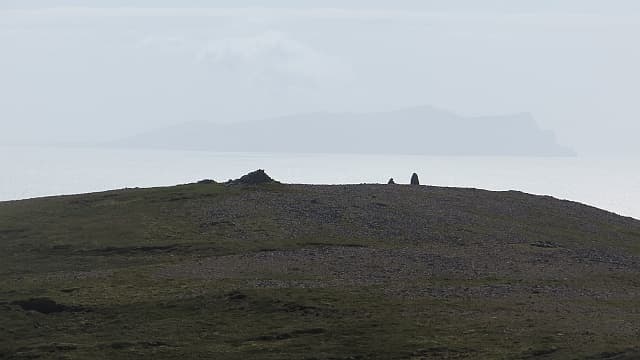
Sandness Hill rises behind the crofting township of the same name in far west Shetland, looking across the Sound to the green cliffs of Papa Stour. At 249m it is a quietly imposing presence at the western edge of the Shetland Mainland, the last hill before the open Atlantic.
Quick facts
- Height
- 249m/ 817ft
- Prominence
- 234 m
- Grid ref
- HU 19165 55708
- Dogs
- Dogs on lead required near livestockDog-friendly guide ↗
Height and prominence cross-checked against the Database of British and Irish Hills (CC BY).
No GPX track yet
Walked this route? Share your track to help other walkers.
Standard route
heather moorland 55% · blanket bog 30% · rocky summit 15%
Walkers usually start from the lane near Sandness, crossing rough grazing and peat ground onto the broad western shoulder before a short steepening to the trig pillar. There is no constructed path; bearings on the broad summit dome matter more than distance.
Terrain
Soft peat hags and tussocky moor grass dominate the lower flanks, with patches of bare gravel near the top. Boots wet through within minutes after rain — gaiters help on the boggier stretches.
In winter
Snow rarely settles long but Atlantic gales sweep straight in off the Foula channel. Daylight in December and January is brief; choose a settled spell and treat exposure, not snow, as the main hazard.
Best time of year
Getting there
- Glasgow13h 17m
- Edinburgh12h 54m
Ferry access
Aberdeen → Lerwick (Shetland)
- Crossing time720 min
- Summer sailingsDaily overnight sailing (Apr–Oct)
- Winter sailingsDaily overnight sailing (Nov–Mar)
- Book ahead14 days
A 12-hour overnight sailing — book a cabin berth. Plan a multi-day Shetland trip; the island is large and the journey is substantial. Flights from Aberdeen/Edinburgh are a faster alternative.
Book on ferry operator ↗OS maps: OS Landranger 3, OS Explorer 467W
Mobile signal: Poor. Remote west Shetland; limited coverage.
Current conditions
Daylight Today
- Sunrise
- 06:31
- Sunset
- 19:34
- Civil dawn
- 05:48
- Civil dusk
- 20:17
NOAA Solar Calculator · 14 September 2026
Sandness Hill — common questions
- Is Sandness Hill a hard climb?
- Sandness Hill is rated 1/5 (easy) on the OutdoorSCOT scale. Underfoot: Soft peat hags and tussocky moor grass dominate the lower flanks, with patches of bare gravel near the top.
- What is Sandness Hill's prominence?
- 234m of prominence. That's the vertical drop from the summit to the col that links Sandness Hill to the next higher ground. That drop is what qualifies it as a Marilyn — a hill with at least 150m of descent on every side.
- When is the best time to climb Sandness Hill?
- March, April, May, June, July, August, September, October give the most reliable conditions on Sandness Hill. Beyond that window the high ground turns wintry: carry full mountain kit, be confident navigating, and check the SAIS avalanche forecast for the area.
- Is Sandness Hill dog-friendly?
- Yes, but dogs must be kept on a lead — there is livestock or ground-nesting bird interest on the route.
- Is there mobile signal on Sandness Hill?
- Poor. Remote west Shetland; limited coverage.
- How do I get the ferry to Sandness Hill?
- Aberdeen → Lerwick (Shetland). Daily overnight sailing (Apr–Oct) in summer; Daily overnight sailing (Nov–Mar) in winter. Book at least 14 days ahead. A 12-hour overnight sailing — book a cabin berth. Plan a multi-day Shetland trip; the island is large and the journey is substantial. Flights from Aberdeen/Edinburgh are a faster alternative.
- Is Sandness Hill safe in winter?
- Snow rarely settles long but Atlantic gales sweep straight in off the Foula channel. Daylight in December and January is brief; choose a settled spell and treat exposure, not snow, as the main hazard.
Get the OutdoorSCOT weekly
One email a week — new route, hill and bothy guides, seasonal conditions and the odd hard-won lesson. No spam, unsubscribe in one click.