Glen
Strath Glass
The Chisholm clan heartland, cleared of almost its entire population between 1801 and the 1830s — the broad strath you drive through to reach Glen Affric has a history worth knowing.
- Corbetts
- 1
- Grahams
- 1
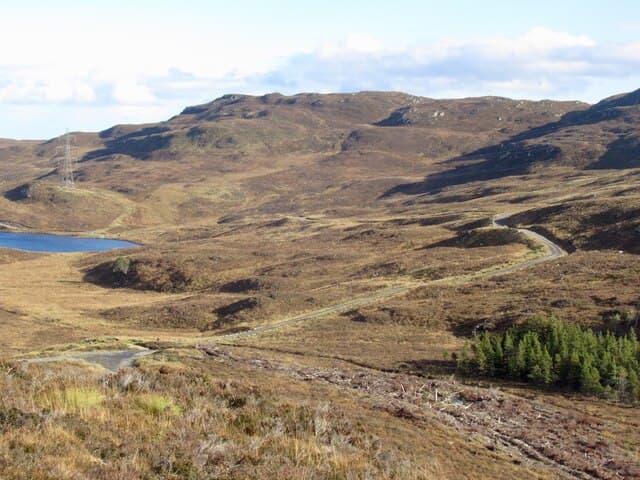
Strath Glass carries the River Glass southwest from the Beauly Firth toward Cannich, where Glen Affric and Glen Cannich branch off into the northern Highland interior. The river drains a large catchment — the waters of Affric, Cannich and Farrar all join the Glass before it becomes the River Beauly below Struy and reaches the Firth at Beauly. The lower strath is agricultural: broad, well-farmed, and relatively densely settled by Highland standards. Above Struy, where the River Farrar joins from Glen Strathfarrar, the valley narrows and the character shifts toward the Highland interior.
Erchless Castle sits in the lower strath near Struy — a tower house of medieval origin, extended in the 16th and 17th centuries, and the historic seat of the Chisholm chiefs. The Chisholms held Strath Glass from at least the 14th century; the strath was their heartland and the clan's identity was bound to it. The castle is still standing, privately occupied, and visible from the road. The landscape around it — open farmland with scattered woodlands — is a direct consequence of what happened to the strath's population in the early 19th century.
Cannich at the inner end is the last settlement with services before the inner glens: fuel, a small shop, accommodation. Above Cannich the road forks — left for Glen Affric, right for Glen Cannich. Strath Glass itself ends here.
The road in
End of road
The strath ends at Cannich village where the road forks — left for Glen Affric, right for Glen Cannich. Cannich is the last fuel and provisions point before the inner glens.
Parking2 spots
Cannich village car park
20 cars
Free
Free village car park. Last fuel and services before Glen Affric and Glen Cannich. Small shop in the village.
Struy layby
6 cars
Free
Rough layby near the Struy bridge where the River Farrar joins the Glass. A natural stopping point when the road to Strathfarrar branches east.
Hills from Strath Glass1 Corbetts · 1 Grahams
Gravel cycling1 route nearby
What's in the glen
Erchless Castle
The historic seat of the Chisholm chiefs — a tower house of medieval origin extended in the 16th and 17th centuries, visible from the road near Struy. The castle was the administrative centre from which the Chisholm Clearances were ordered in the early 19th century. Privately occupied; not open to visitors. The surrounding landscape is direct evidence of those clearances — broad farmland where a population of thousands once lived.
Fasnakyle Power Station
The Fasnakyle hydroelectric power station near Cannich receives water from the Affric-Beauly scheme — tunnels draining Loch Benevean (Glen Affric) and Loch Mullardoch (Glen Cannich). Built in the 1950s as part of the North of Scotland Hydro-Electric Board's Breadalbane-equivalent programme for the northern Highlands. The building is functional 1950s industrial architecture; the turbines are still operational.
River Glass
Our take
Drive this strath slowly enough to notice what it is. The farming landscape is comfortable and unremarkable — broad fields, estate steadings, occasional glimpses of the river. It does not look like a place that was once filled with people who were removed by force. Stop briefly at Struy where the River Farrar joins from the east and the road to Strathfarrar branches off. Fill up at Cannich. Then go further in. But the strath has earned more than a glance at a petrol pump.
History
Strath Glass was the heartland of Clan Chisholm — one of the smaller Highland clans, but one whose territorial identity was almost entirely contained within this single valley. The Chisholms had held the strath from the 14th century and the relationship between the clan and the land was unusually concentrated. The Gaelic phrase associated with them — Às an Eilthireachd, "from the exile" — acquired a specific meaning in the 19th century.
Between 1801 and the late 1830s, William Chisholm and his son carried out a systematic clearance of the strath's population to make way for sheep farming. Families who had occupied the same ground for generations were evicted — some with weeks of notice, some with less. The population of the strath, estimated at around 5,000 at the end of the 18th century, was reduced to a fraction of that. Many who were cleared emigrated to Nova Scotia, Prince Edward Island and Upper Canada; Chisholm settlements in these provinces trace directly to the Strath Glass clearances. The forced emigration ships from this period were documented in contemporary accounts that formed part of the growing 19th century record of Highland depopulation.
The Chisholm Clearances were particularly complete. Unlike some Highland estates where cleared land retained remnant crofting settlements, Strath Glass was largely converted to sheep walk. The landscape today — broad agricultural strath, well-farmed but sparsely populated — is the direct result. Erchless Castle, the Chisholm seat from which the clearances were ordered, remains standing near Struy. The clan chiefs who authorised the removals are buried in the grounds.
Practical
- Mobile signal
- Reasonable signal in the lower strath and at Cannich. Limited beyond Cannich toward the inner glens.
- Midges
- Moderate(3/5)
- Public transport
- Stagecoach bus from Inverness to Cannich (service 17A). No public transport beyond Cannich.
- Dogs
- On lead — livestock or ground-nesting birds present.
Map
Hills (green), bothies (brown), parking (blue), wild swimming (light blue).
Nearby glens
Scotland outdoor updates
Route guides, condition reports and seasonal picks — once a month, no noise.
Strath Glass — common questions
- What's the road into Strath Glass like?
- B_road. The strath ends at Cannich village where the road forks — left for Glen Affric, right for Glen Cannich. Cannich is the last fuel and provisions point before the inner glens.
- Is Strath Glass suitable for motorhomes and campervans?
- Yes — Strath Glass is suitable for motorhomes and campervans. Take care on any single-track sections and use passing places to let local traffic past.
- How bad are the midges in Strath Glass?
- Strath Glass's midge rating is 3/5 — significant from late May to September. Sheltered, humid evenings are the worst; high wind and the high tops are safest. Carry Smidge and a head net from May onwards.
- Is wild camping allowed in Strath Glass?
- Wild camping in Scotland is legal under the Land Reform Act 2003 on most unenclosed land, subject to the Scottish Outdoor Access Code. Avoid enclosed agricultural ground, camp in small numbers, and leave no trace. The Loch Lomond and Trossachs Camping Management Zones (which restrict wild camping in marked areas March-September) do not apply to Strath Glass.
- Is there public transport to Strath Glass?
- Stagecoach bus from Inverness to Cannich (service 17A). No public transport beyond Cannich.