Glen
Glen Rosa
A sea crossing, a 3km walk, and then granite mountains above a glacial trough — the most complete mountain day reachable from Glasgow without a car.
- Corbetts
- 2
- Highest peak
- Goat Fell (874m)
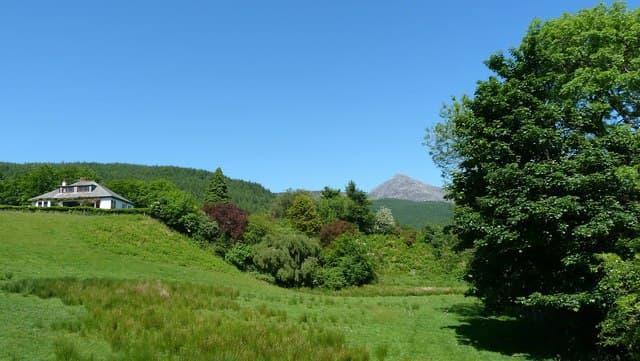
Glen Rosa has no road. To reach it from Glasgow you take the train to Ardrossan (50 minutes), the CalMac ferry to Brodick (55 minutes crossing), and then walk 3km from the ferry terminal to the glen entrance — around two and a half hours door to glen. There is no shortcut and no alternative. The Rosa Water runs south through the glen from the granite mountains above, and the walk in follows the river through farmland before the valley narrows and the mountains close in. Most Arran hill days start here.
The mountains at the head of the glen are part of the Northern Granite — a roughly circular igneous intrusion about 9km across that forms all the main summits: Goat Fell (874m), Cir Mhor (799m), and the A'Chir ridge between them. The granite is coarse-grained and rough-textured, giving excellent friction for scrambling in dry conditions and a specific quality of mountain feel different from the schist and sandstone of the mainland Highlands. Goat Fell, the island's highest point, is accessible to most fit walkers via a clear path from Brodick Castle or from the glen. The A'Chir ridge is a different proposition — a narrow exposed scramble with genuine route-finding on rough rock, requiring handholds and comfort with exposure.
The island is small enough to structure a full day around the glen: early ferry, glen approach, summit by midday, descent by mid-afternoon, time for food in Brodick before the last boat. Late ferries run until around 8pm in summer, giving a realistic window even if the hill takes longer than planned.
The road in
Parking1 spot
Brodick ferry terminal area
Large ferry car park
Free
No road access into Glen Rosa — all walkers approach on foot from Brodick. The ferry terminal car park is 3km from the glen entrance.
Hills from Glen Rosa2 Corbetts
What's in the glen
A'Chir ridge
The A'Chir ridge is the technical highlight of the Arran granite mountains — a narrow, exposed ridge with genuine scrambling sections requiring handholds on rough granite. Not suitable for walkers without scrambling experience. Views across to the Kintyre peninsula, Ailsa Craig and the Irish coast on clear days.
Coire Daingean
The glacial corrie above upper Glen Rosa — a classic U-shaped hanging valley above the main glen trough. The corrie holds a small lochan and gives access to the main Arran ridge. The granite rock scenery here is among the best on Arran.
Goat Fell
Goat Fell (874m) is Arran's highest point and the island's most climbed mountain. The NTS-managed summit is accessible to most fit walkers via a clear path from Brodick Castle or from Glen Rosa itself — the glen approach is less busy and gives a better sense of the mountain's scale. The summit view extends to the Irish coast (Antrim), Kintyre, the Ayrshire shore and, on very clear days, Snowdonia. The name is likely from the Old Norse *geita-fjall* (goat mountain) rather than from the animal — the same Norse naming pattern as much of Arran's landscape.
Rosa Water
Our take
Book the earliest ferry from Ardrossan and walk straight from Brodick terminal — do not linger in the village on the way in. The walk to the glen entrance takes 40 minutes and the approach to the ridge another hour beyond that. For Goat Fell, the path from the glen is longer than the Brodick Castle route but quieter. For the A'Chir ridge, allow a full day and do not attempt it in wet conditions — the granite is excellent when dry and dangerous when not. The return ferry gives you a hard deadline, which concentrates the day helpfully. May or September for the crossing: summer crowds on the ferry and on Goat Fell are significant.
History
Arran was Norse for nearly 500 years. Viking settlement began around 800 AD and Norse political control of the Hebrides lasted until the Battle of Largs in 1263 and the Treaty of Perth in 1266, which transferred sovereignty to the Scottish crown. Place names on Arran reflect this: "Rosa" may derive from the Old Norse rós (headland or promontory), as do several other Arran names. The island's position in the Firth of Clyde made it strategically important to Norse sea-lanes between Norway and Ireland. The granite mountains of the north — Glen Rosa's watershed — would have been as visible to Norse longships entering the Firth as they are to CalMac ferries today.
The Hamilton family, who held Arran as a dukedom from the 17th century, carried out significant clearances on the island in the 1820s and 1840s. Farming townships in the northern glens and upland areas were cleared to make way for sheep and deer. Some of those displaced went to Megantic County in Quebec, where place names — including Arran itself — reflect the forced emigration. The southern lowland parts of Arran were less affected, which is why Brodick and the southern coast have a different settlement pattern from the emptier northern interior.
The Arran granite intrusion was studied by the geologist James Hutton in the late 18th century as part of the evidence for his Theory of the Earth — the foundational argument that the Earth was vastly older than biblical chronology suggested and that geological processes operated over deep time. Hutton's famous unconformity on Arran is at Newton Point on the north coast rather than in Glen Rosa, but the granite mass that forms the Rosa mountains was part of the same evidence base. The island became a standard geological field site and remains one.
Practical
- Mobile signal
- Signal in Brodick. Patchy in the glen, none in the high corries.
- Midges
- Moderate(3/5)
- Public transport
- CalMac ferry from Ardrossan to Brodick. Walk from Brodick ferry terminal.
- Dogs
- On lead — livestock or ground-nesting birds present.
Map
Hills (green), bothies (brown), parking (blue), wild swimming (light blue).
Scotland outdoor updates
Route guides, condition reports and seasonal picks — once a month, no noise.
Glen Rosa — common questions
- What's the road into Glen Rosa like?
- No_road. Give yourself more driving time than the map suggests.
- Is Glen Rosa suitable for motorhomes and campervans?
- Not recommended. Glen Rosa has narrow sections, tight turns, or limited passing space that make it difficult for motorhomes and large campervans. Park at the road end of a wider valley and continue on foot.
- How bad are the midges in Glen Rosa?
- Glen Rosa's midge rating is 3/5 — significant from late May to September. Sheltered, humid evenings are the worst; high wind and the high tops are safest. Carry Smidge and a head net from May onwards.
- Is wild camping allowed in Glen Rosa?
- Wild camping in Scotland is legal under the Land Reform Act 2003 on most unenclosed land, subject to the Scottish Outdoor Access Code. Avoid enclosed agricultural ground, camp in small numbers, and leave no trace. The Loch Lomond and Trossachs Camping Management Zones (which restrict wild camping in marked areas March-September) do not apply to Glen Rosa.
- Is there public transport to Glen Rosa?
- CalMac ferry from Ardrossan to Brodick. Walk from Brodick ferry terminal.