Marilyn · Outer Hebrides
Stac an Armin
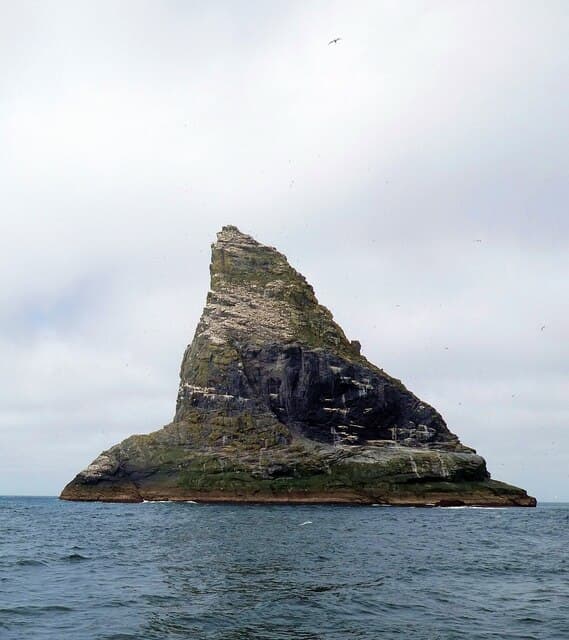
Stac an Armin, in the NA 151 grid square just north of Boreray, is the tallest sea stack in Britain at 197m. The Marilyn classification masks the reality that this is a vertical rock pillar surrounded by deep Atlantic water and home to a vast colony of gannets and other seabirds.
Quick facts
- Height
- 197.3m/ 647ft
- Prominence
- 197 m
- Grid ref
- NA 15132 06417
- Dogs
- Dogs on lead required near livestockDog-friendly guide ↗
Height and prominence cross-checked against the Database of British and Irish Hills (CC BY).
No GPX track yet
Walked this route? Share your track to help other walkers.
Standard route
bare rock 80% · seabird colony 20%
A serious sea-cliff climb rather than a walk. Boats from Harris or Skye drop climbers at the only landing ledge in unusually calm seas, and a roped ascent of grass-mixed rock reaches the small summit. Allow a full day for the attempt.
Terrain
Sheer gabbro and dolerite walls plastered with guano and tussock grass, and ledges crowded with nesting gannets. The rock is mossy and slippery and protection is sparse.
In winter
No winter access whatsoever. The stack is climbable only in flat-calm summer conditions when boats can hold position long enough to put climbers ashore.
Best time of year
Getting there
- Glasgow12h 10m
- Edinburgh15h 37m
Ferry access
Private charter from Leverburgh (Harris) or Oban
- Crossing time180 min
- Summer sailingsNo regular service — chartered day trips and stays May–Sep only, weather dependent
- Winter sailingsNo access in winter
- Book ahead90 days
St Kilda is 64km west of the Outer Hebrides — one of the most remote places in Britain. Access by private charter boat (weather permitting) or NTS-arranged visits. Camping and bothy accommodation available; no day trips possible.
OS maps: OS Landranger 18, OS Explorer 460W
Mobile signal: None. St Kilda sea stack; completely off-grid.
Current conditions
Daylight Today
- Sunrise
- 07:01
- Sunset
- 19:58
- Civil dawn
- 06:21
- Civil dusk
- 20:38
NOAA Solar Calculator · 14 September 2026
Stac an Armin — common questions
- Is Stac an Armin a hard climb?
- Stac an Armin is rated 1/5 (easy) on the OutdoorSCOT scale. Terrain: Sheer gabbro and dolerite walls plastered with guano and tussock grass, and ledges crowded with nesting gannets.
- How prominent is Stac an Armin?
- Stac an Armin's prominence is its full height — 197m — because it is the highest point of its landmass, with no higher ground connected to it. Marilyns are defined by that measure: at least 150m of drop on all sides.
- When should I climb Stac an Armin?
- The standard good-weather months for Stac an Armin are March, April, May, June, July, August, September, October. Outside those months, expect winter conditions on the high ground — full mountain kit, navigation skills, and a check of the SAIS avalanche forecast for the relevant region.
- Can I bring my dog up Stac an Armin?
- On a lead only — the route crosses ground with livestock or nesting-bird interest.
- What's mobile reception like on Stac an Armin?
- None. St Kilda sea stack; completely off-grid.
- How do I get the ferry to Stac an Armin?
- Private charter from Leverburgh (Harris) or Oban. No regular service — chartered day trips and stays May–Sep only, weather dependent in summer; No access in winter in winter. Book at least 90 days ahead. St Kilda is 64km west of the Outer Hebrides — one of the most remote places in Britain. Access by private charter boat (weather permitting) or NTS-arranged visits. Camping and bothy accommodation available; no day trips possible.
- Is Stac an Armin safe in winter?
- No winter access whatsoever. The stack is climbable only in flat-calm summer conditions when boats can hold position long enough to put climbers ashore.
Get the OutdoorSCOT weekly
One email a week — new route, hill and bothy guides, seasonal conditions and the odd hard-won lesson. No spam, unsubscribe in one click.