Graham · Argyll & Bute
Beinn a' Chaolais
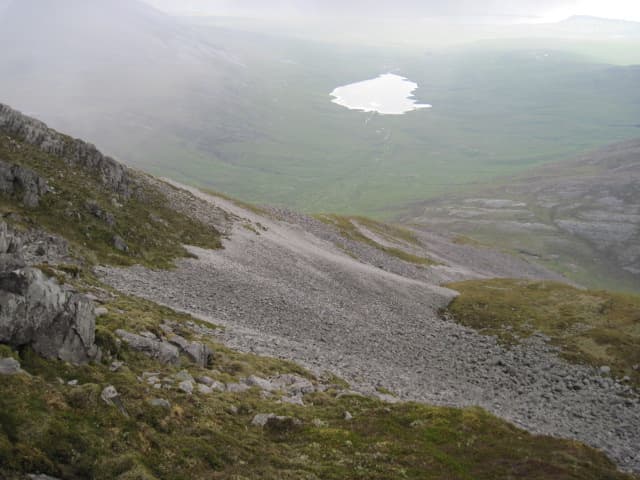
The most southerly of the three Paps of Jura — the smallest and least visited, but still a defining feature of the Sound of Islay skyline. Steep slopes of pale quartzite tumble straight to sea level.
Quick facts
- Height
- 735.2m/ 2412ft
- Prominence
- 361 m
- Distance
- ~14 km
- Ascent
- ~603 m
- Time
- 4–7 hrs
- Grid ref
- NR488734
- Parking
- NR495740
- Nearest
- Oban
- Dogs
- Dogs on lead required near livestockDog-friendly guide ↗
Height and prominence cross-checked against the Database of British and Irish Hills (CC BY).
No GPX track yet
Walked this route? Share your track to help other walkers.
Standard route
island track 15% · rough bog 20% · quartzite scree 45% · summit area 20%
Start from the Three Arch Bridge on the Feolin road. Cross the moor north-west to the south-west spur and tackle the quartzite scree directly. The summit cone is loose and steep — pick a line carefully on the descent.
Terrain
Long approach over heather and bog, then a punishing climb on shifting quartzite scree. Hands are sometimes needed on the upper cone. The descent is harder than the ascent.
In winter
Snow on Jura is rare and never deep but the wet quartzite becomes lethal when iced. Atlantic winds rip across the Sound of Islay all winter — exposure on the upper cone is total.
Kit for this: the winter Munro kit list · which boots take crampons
Best time of year
Getting there
- Glasgow3h 51m
- Edinburgh4h 53m
Ferry access
Kennacraig → Port Askaig (Islay) then Port Askaig → Feolin (Jura)
- Crossing time145 min
- Summer sailingsIslay: 1–2 CalMac sailings daily. Jura ferry: frequent throughout the day
- Winter sailingsIslay: 1 CalMac sailing daily. Jura ferry: reduced but regular
- Book ahead21 days
- Last ferry backLast Jura ferry ~17:00; last Islay sailing varies — check both timetables
Two ferries required: CalMac Kennacraig → Port Askaig (2h15), then the short Jura passenger ferry (10 min) from Port Askaig to Feolin. No car needed once on Jura for the Paps.
Book on ferry operator ↗OS maps: OS Landranger 60, OS Landranger 61
Mobile signal: Patchy on the western side of Jura; better reception toward Craighouse
Current conditions
Daylight Today
- Sunrise
- 07:52
- Sunset
- 18:28
- Civil dawn
- 07:15
- Civil dusk
- 19:05
NOAA Solar Calculator · 14 October 2026
Pair with
Curated multi-hill combinations from Beinn a' Chaolais.
Around Beinn a' Chaolais on the SCOT network
Getting there, basing yourself, and what to do off the hill.
Beinn a' Chaolais — common questions
- Is Beinn a' Chaolais a hard climb?
- Beinn a' Chaolais is rated 4/5 (challenging) on the OutdoorSCOT scale. The standard route covers about 14km with 603m of ascent and takes most walkers 4-7 hours. Underfoot: Long approach over heather and bog, then a punishing climb on shifting quartzite scree.
- What is Beinn a' Chaolais's prominence?
- 361m of prominence. That's the vertical drop from the summit to the col that links Beinn a' Chaolais to the next higher ground.
- Where do I park for Beinn a' Chaolais?
- Most walkers start from NR495740 near Oban. Verify the grid reference on an OS map before you set off — space is tight on busy summer weekends.
- When is the best time to climb Beinn a' Chaolais?
- May, June, July, August, September give the most reliable conditions on Beinn a' Chaolais. Beyond that window the high ground turns wintry: carry full mountain kit, be confident navigating, and check the SAIS avalanche forecast for the area.
- Is Beinn a' Chaolais dog-friendly?
- Yes, but dogs must be kept on a lead — there is livestock or ground-nesting bird interest on the route.
- Is there mobile signal on Beinn a' Chaolais?
- Patchy on the western side of Jura; better reception toward Craighouse
- How do I get the ferry to Beinn a' Chaolais?
- Kennacraig → Port Askaig (Islay) then Port Askaig → Feolin (Jura). Islay: 1–2 CalMac sailings daily. Jura ferry: frequent throughout the day in summer; Islay: 1 CalMac sailing daily. Jura ferry: reduced but regular in winter. Book at least 21 days ahead. Two ferries required: CalMac Kennacraig → Port Askaig (2h15), then the short Jura passenger ferry (10 min) from Port Askaig to Feolin. No car needed once on Jura for the Paps.
- Is Beinn a' Chaolais safe in winter?
- Snow on Jura is rare and never deep but the wet quartzite becomes lethal when iced. Atlantic winds rip across the Sound of Islay all winter — exposure on the upper cone is total.
Get the OutdoorSCOT weekly
One email a week — new route, hill and bothy guides, seasonal conditions and the odd hard-won lesson. No spam, unsubscribe in one click.