Glen
Glen Tanar
One of the better-managed Caledonian pinewoods on Deeside, an ancient trans-Cairngorm road still walkable today, and the most easterly Munro approached from the south.
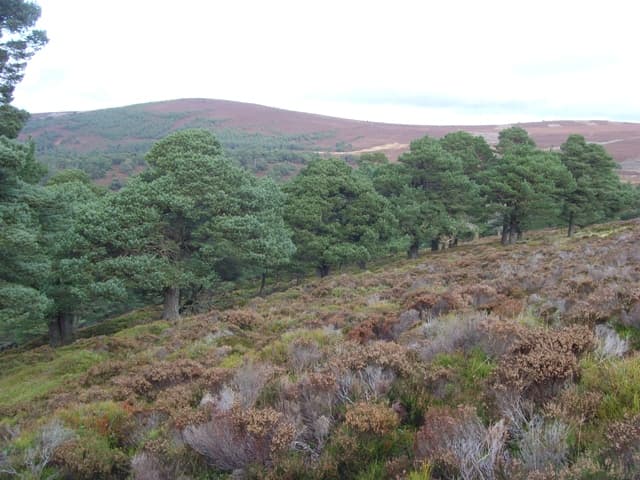
Glen Tanar Estate lies west of Aboyne on Royal Deeside — a private estate managed with a degree of visitor infrastructure unusual in this part of the Cairngorms. The visitor centre near the glen entrance has maps, toilets and information; waymarked trails of varying length run through Caledonian pinewoods that are among the more intact on the eastern side of the park. Individual trees reach 400 years; capercaillie and crested tit are reliably present. The estate has invested in pinewood conservation for several decades and the forest quality shows it.
The upper glen follows the Water of Tanar toward the watershed — and toward one of the ancient Mounth roads. The Firmounth Road is a trans-Cairngorm route that has been in continuous use since at least the medieval period, crossing from Deeside over the high moor to Glen Esk in Angus. Drovers used it to move cattle between highland and lowland markets; soldiers used it during the Jacobite campaigns; pilgrims used it heading south. The ruined Chapel of Glenmark near the watershed is associated with this pilgrimage traffic. Mount Keen (939m), the most easterly Munro in Scotland, sits at the top of the Firmounth approach — a long but technically straightforward hill that most walkers approach from this direction or from Glen Esk to the south.
The round trip from the visitor centre to Mount Keen and back is 24km with 700m of ascent — a full day without being technically demanding. The Firmounth Road itself, even without the summit, is worth walking as a historical route.
The road in
Single-track road etiquette
Pull into passing places to let oncoming vehicles pass. Don't park in passing places. If a faster vehicle is behind you, pull over and let them past. Do not reverse at speed — wait in a passing place.
End of road
The estate road ends at the visitor centre car park. Beyond is a managed estate track network — foot and cycle only, with waymarked trails through the pinewoods and the Firmounth Road continuing to the upper watershed.
Parking1 spot
Glen Tanar visitor centre
30 cars
Free
Main estate car park with toilets and information boards. Start point for all glen trails and the Firmounth Road approach to Mount Keen.
What's in the glen
Glen Tanar native pinewoods
One of the more intact Caledonian pinewood remnants on the eastern Cairngorms — ancient Scots pine to 400 years, with active estate conservation management and natural regeneration. Capercaillie, crested tit and red squirrel are reliably present. The waymarked trail network makes this accessible without route-finding; the forest quality is genuinely high.
Mount Keen
Mount Keen (939m) is the most easterly Munro in Scotland — a long, rounded hill with a straightforward ascent via the Firmounth Road from Glen Tanar visitor centre. The round trip is 24km with 700m ascent. Views extend across the Angus lowlands and east toward the North Sea on clear days. Can also be approached from Glen Esk to the south.
Chapel of Glenmark
A ruined pre-Reformation chapel near the Firmounth watershed, associated with pilgrims crossing the Mounth from Deeside to the Angus glens. The chapel is dedicated to St Mark and appears in medieval ecclesiastical records. The footprint is visible; the site is on the Firmounth Road route toward Mount Keen.
Water of Tanar
Our take
Glen Tanar works well precisely because it is managed — the trails are clear, the pinewoods are in good condition, and you can do a half-day forest walk or a full-day Munro without having to navigate a locked gate or an unmarked approach. The Firmounth Road is the draw that sets Tanar apart from other Cairngorms estate walks: you are walking a route used continuously for a thousand years, and the landscape it crosses is largely unchanged. For Mount Keen, this is the southern Deeside approach — longer than Glen Esk but starting from better infrastructure.
History
The Mounth was the collective name for the high plateau of the eastern Cairngorms and the passes crossing it — a barrier between the Highland north and the agricultural south that forced travellers onto specific high routes regardless of season. The Firmounth Road through Glen Tanar was one of the most used: it connected Aboyne and Deeside with Glen Esk, the Angus lowlands and ultimately the east coast ports. The road appears in documentary records from the 12th century but almost certainly predates written records; the crossing was used by armies, cattle drovers, merchants and pilgrims for whom there was no easier alternative.
The Chapel of Glenmark near the Firmounth watershed is associated with this pilgrimage traffic — a pre-Reformation chapel that provided shelter and spiritual services for travellers crossing the high ground. The site is now ruined but the footprint is visible. The chapel is dedicated to St Mark and appears in ecclesiastical records from the medieval period.
Glen Tanar Estate itself was developed into its current form by the Coats family — the Paisley thread manufacturers — who acquired it in the early 20th century and invested substantially in the infrastructure and woodlands. The visitor centre, the maintained path network and the conservation management of the pinewoods all reflect an estate that was run as a serious long-term land holding rather than a purely sporting property. The estate remains privately owned and managed.
Practical
- Mobile signal
- Signal at the visitor centre. Patchy in the lower glen, none on the hills or upper Firmounth Road.
- Midges
- Low–moderate(2/5)
- Public transport
- Bus to Aboyne from Aberdeen. Glen Tanar visitor centre is 5km from Aboyne — taxi or cycle required.
- Dogs
- On lead — livestock or ground-nesting birds present.
Map
Hills (green), bothies (brown), parking (blue), wild swimming (light blue).
Nearby glens
Scotland outdoor updates
Route guides, condition reports and seasonal picks — once a month, no noise.
Glen Tanar — common questions
- How's the drive into Glen Tanar?
- Single-track with passing places. The estate road ends at the visitor centre car park. Beyond is a managed estate track network — foot and cycle only, with waymarked trails through the pinewoods and the Firmounth Road continuing to the upper watershed.
- Can you drive a campervan into Glen Tanar?
- Best avoided in a big vehicle. Narrow sections, tight turns or scarce passing space make Glen Tanar awkward for motorhomes and large campervans — park in a wider valley and walk in.
- Will midges be a problem in Glen Tanar?
- We rate Glen Tanar 2/5 for midges — moderate between late May and September. Still, humid evenings are peak biting time; wind and height are your friends. Pack Smidge and a head net from May.
- Is it legal to wild camp in Glen Tanar?
- Yes. Under the Land Reform Act 2003 you can wild camp on most unenclosed land in Scotland, provided you follow the Scottish Outdoor Access Code — keep off enclosed farmland, camp in small groups, and leave no trace. Glen Tanar sits outside the Loch Lomond and Trossachs Camping Management Zones, so the March-September permit restrictions there don't apply here.
- How do I reach Glen Tanar by public transport?
- Bus to Aboyne from Aberdeen. Glen Tanar visitor centre is 5km from Aboyne — taxi or cycle required.