Glen
Glen Esk
The most easterly and most agricultural of the Angus Glens — an approachable introduction to eastern Cairngorms walking with good Pictish history nearby.
- Munros
- 1
- Corbetts
- 1
- Grahams
- 1
- Bothies
- 1
- Highest peak
- Mount Keen (939.4m)
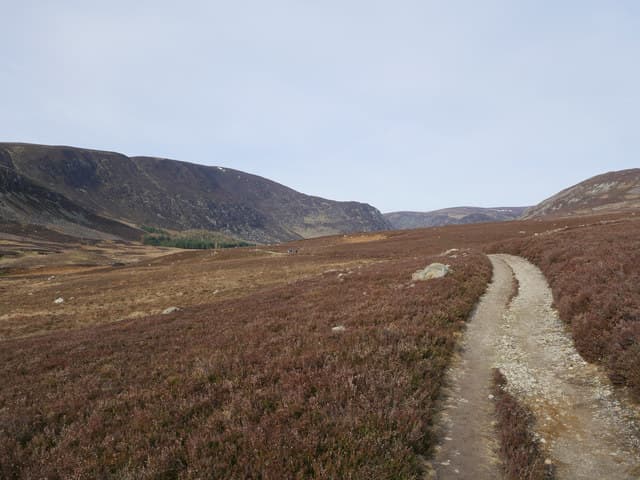
Glen Esk runs north from Edzell on the edge of the Angus farming lowlands into the eastern foothills of the Cairngorms. It is the most agricultural and least dramatic of the Angus Glens — broader, gentler, and with more working farms along its length. The Retreat Museum at Loch Lee (a converted shooting lodge) is one of the most unexpected small museums in Scotland, with a collection of local history and folk artefacts.
Hill walks from the glen head give access to Mount Keen (939m), the most easterly Munro in Scotland — a long but technically straightforward hill that can also be approached from Deeside. The glen is popular with cyclists as well as walkers.
The road in
Parking2 spots
Invermark car park
20 cars
Free
Rough layby at the glen head near Invermark castle. Main parking for Mount Keen approaches.
Glenesk Museum car park
15 cars
Free
At The Retreat museum near Loch Lee. Small car park.
Hills from Glen Esk1 Munros · 1 Corbetts · 1 Grahams
Bothies in the glen1 in range
What's in the glen
Glenesk Folk Museum (The Retreat)
The Retreat is a converted Victorian shooting lodge that houses the Glenesk Folk Museum — a collection of local artefacts, photographs and records documenting the social history of the Angus Glens from the 18th century onwards. One of the more unexpected small museums in rural Scotland.
Invermark Castle
The ruins of Invermark Castle at the glen head — a 16th century tower house built by the Lindsay family. The castle controlled the glen entrance and the drove road over to Deeside. The ruins are accessible and partially stable.
Loch Lee
A small loch near the Retreat museum with a ruined church on its shore. The area was an important settlement site and the church remains are from the medieval period.
Our take
Glen Esk is the Angus Glen for people who want a good day out without any of the pressure of the higher-profile glens. Mount Keen from the glen head is a satisfying Munro with minimal technical difficulty. The lower glen is good for cycling.
History
Glen Esk has been continuously settled longer than most Scottish glens — the valley's agricultural land and relatively accessible southern position made it more hospitable than the remoter northwest. Pictish carved stones have been found in the lower glen, and the distribution of early medieval settlement sites suggests a dense early population.
The Glenesk Folk Museum at The Retreat is the primary resource for the glen's recorded history. Founded in 1955 using a collection assembled by Greta Michie over several decades, it documents agricultural life, the estate system and the social structure of the Angus Glens from the 18th century. The archive is particularly strong on 19th century records.
Practical
- Mobile signal
- Reasonable signal in the lower glen. None at the glen head.
- Midges
- Low–moderate(2/5)
- Public transport
- Bus to Edzell from Brechin. No public transport beyond Edzell into the glen.
- Dogs
- On lead — livestock or ground-nesting birds present.
Map
Hills (green), bothies (brown), parking (blue), wild swimming (light blue).
Nearby glens
Scotland outdoor updates
Route guides, condition reports and seasonal picks — once a month, no noise.
Glen Esk — common questions
- What kind of road runs through Glen Esk?
- B_road. Build in extra time for the approach.
- Can I take a motorhome or campervan into Glen Esk?
- Glen Esk works for motorhomes and campervans. Just take the single-track stretches steadily and use the passing places so local traffic can get past.
- Are there midges in Glen Esk?
- Expect a moderate midge season in Glen Esk (2/5), running late May to September. The worst of it comes on sheltered, humid evenings — breezy spots and the high tops stay clearer. Smidge and a head net earn their place from May onwards.
- Can I wild camp in Glen Esk?
- You can. Scotland's Land Reform Act 2003 gives a right to wild camp on most unenclosed land, subject to the Scottish Outdoor Access Code: stay off enclosed agricultural ground, keep numbers small, leave no trace. Note the Loch Lomond and Trossachs Camping Management Zones and their seasonal restrictions do not cover Glen Esk.
- Can I get to Glen Esk without a car?
- Bus to Edzell from Brechin. No public transport beyond Edzell into the glen.