gear
Best Camping Stoves for Wild Camping in Scotland
Scottish wind kills stoves. The gas, meths and multi-fuel options that actually work when it's blowing sideways at 600m, plus the one question nobody asks before buying.
Some links in this article are affiliate links. If you click through and make a purchase, OutdoorSCOT may earn a commission at no extra cost to you. This never affects what we recommend. Full disclosure.
Quick Summary
- Wind is the stove-killer in Scotland, not cold — a canister stove without a windshield takes 3x longer to boil in 15mph wind, and most Scottish camps have 15mph wind
- Three fuel types work: gas canisters (lightest, fastest, worst in wind), meths/alcohol (silent, reliable, slow), and multi-fuel/petrol (bombproof, heavy, expensive)
- The MSR Pocket Rocket 2 is the default gas recommendation at £60, but the Soto Windmaster (£75) outperforms it in Scottish wind conditions
- Check what you need — our Gear Checklist Generator builds a complete Scotland-specific wild camping kit list including stove, fuel and cook kit
The question everyone asks is "what's the best camping stove?" The question nobody asks is "will it work in a 20mph crosswind at 500m in horizontal rain while you're wearing gloves?" In Scotland, the second question is the one that matters. Every stove works in your kitchen. Very few work well on a west Highland evening when the weather is doing what it does best.
Here is what actually matters.
Quick Answer: For most Scottish wild camping, a gas canister stove with wind protection is the best compromise of weight, speed and reliability. The Soto Windmaster (£75) with its wind-resistant burner head is the best performer in Scottish conditions. The MSR Pocket Rocket 2 (£60) is lighter and cheaper but needs a separate windshield to match the Windmaster's wind performance. For reliability in all conditions including deep winter, a Trangia 25 meths stove (£70) is indestructible, silent and works in any wind — it is just slower. Multi-fuel stoves (MSR Whisperlite, Primus Omnifuel) are overkill for UK use unless you are winter camping above 800m.
The fuel types, honestly
Gas canister stoves
The default choice for most UK backpackers and the right choice for 80% of Scottish wild camping.
How they work: Screw-on stoves that burn isobutane/propane from pressurised canisters. Turn the valve, click the piezo igniter, blue flame, boiling water in 3-4 minutes.
Pros: Lightest option (stove weighs 70-120g). Fastest boil time. Cleanest flame. Precise simmer control. Instant on/off.
Cons: Performance drops below 5°C (the gas struggles to vaporise). Useless below -10°C without workarounds. Wind destroys efficiency without a shield. Canisters are not refillable and create waste. You cannot tell how much fuel remains by weight until you are experienced.
The wind problem: A standard upright canister stove in 15mph wind — which is a gentle breeze on a Scottish hilltop — loses 50-70% of its heat output. The flame deflects sideways, the pot never reaches full boil, and a 3-minute boil becomes 10 minutes. You solve this with either a wind-resistant burner design (Soto Windmaster) or a foil windshield (MSR, Toaks) placed around the stove. Do not use a windshield that traps heat around the canister — the canister can overheat and explode.
Meths/alcohol stoves
The traditional choice and still the best for simplicity and reliability.
How they work: Liquid methylated spirits burns in an open or semi-enclosed burner. The Trangia system is the classic — a brass burner inside a windshield/pot-support system that protects the flame from wind.
Pros: No moving parts. Nothing to break. Works in any temperature including deep winter. Silent (gas stoves roar). Fuel is cheap and available everywhere (Tiso, hardware shops, B&Q). The Trangia system includes its own windshield so wind performance is built in.
Cons: Slower boil time (6-8 minutes vs 3-4 for gas). Heavier system overall (Trangia 25 is 740g without fuel). No precise simmer control. The flame is nearly invisible in daylight — check before touching.
The Scottish case: A Trangia in a Scottish gale will boil water when a canister stove has given up. The integrated windshield makes it essentially windproof. It is the stove to carry on winter trips and on any trip where you expect sustained wind. It is slower but it keeps working.
Multi-fuel stoves
Burn petrol, diesel, paraffin, white gas or aviation fuel through a pressurised jet. The MSR Whisperlite and Primus Omnifuel are the classics.
Pros: Work in any temperature, any altitude, any conditions. Fuel available globally. The most reliable stove type in extreme cold.
Cons: Heavy (300g+ for stove alone, plus fuel bottle). Expensive (£120-160). Require priming and maintenance. Loud. Messy. Smell of petrol.
Who needs one: Winter mountaineers camping above 800m in Scotland. Expedition campers. People going to places where gas canisters are unavailable. Not most wild campers.
Try it yourself
builds a Scotland-specific wild camping kit list including stove recommendations matched to your season, activity and experience level.
No sign-up required.The specific recommendations
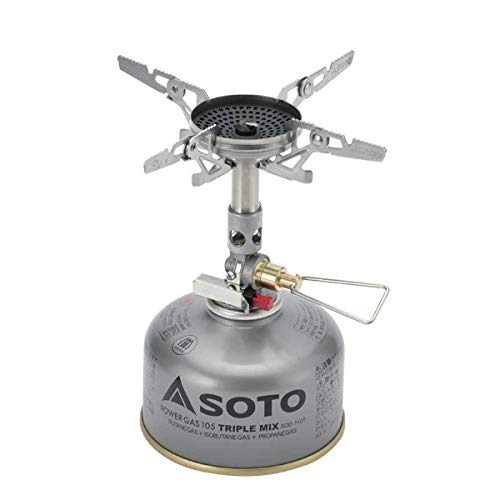
Soto WindMaster
~£75
The wind-resistant burner that actually holds a flame in Scottish gusts — the one to buy if you camp exposed.
Check price at Amazon
MSR PocketRocket 2
~£38
The benchmark lightweight gas stove — tiny, reliable, and the default first backpacking stove.
Check price at Amazon
Trangia 25
~£61
Silent, fuel-flexible and near-indestructible meths cookset — the traditional Scottish choice that lasts a lifetime.
Check price at Amazon| Stove | Type | Weight | Price | Boil time (sheltered) | Wind performance | Best for |
|---|---|---|---|---|---|---|
| Soto Windmaster(affiliate link) | Gas | 87g | £75 | 3 min | Excellent (built-in) | Year-round Scotland |
| MSR Pocket Rocket 2(affiliate link) | Gas | 73g | £60 | 3.5 min | Poor without shield | Summer, with windshield |
| Jetboil Flash | Gas integrated | 371g | £110 | 100 sec | Good (shielded pot) | Speed priority, solo |
| Trangia 25 | Meths | 740g | £70 | 7 min | Excellent (system) | Reliability, winter, groups |
| Trangia 25 + gas kit | Meths/gas | 790g | £95 | 4 min (gas) / 7 min (meths) | Excellent | Best all-rounder |
| MSR Whisperlite | Multi-fuel | 330g | £130 | 4 min | Good | Winter mountaineering |
A sensible split: Soto Windmaster for summer solo trips, Trangia 25 with gas conversion for winter and group trips. In UK conditions the Trangia does everything the MSR Whisperlite does; the Whisperlite is a winter mountaineering stove.
Cook kit
The stove is half the system. You also need:
- Pot: 1L for solo, 1.5-2L for two people. Titanium is lightest (£30-50). Aluminium is cheapest (£10-15). Hard-anodised aluminium is the best middle ground.
- Mug: Titanium (£15) or your pot doubles as a mug for solo trips.
- Spork: Long-handled titanium or plastic. £5-10.
- Lighter + backup lighter: Never rely on a single piezo igniter. Carry a disposable Bic lighter in a waterproof bag.
- Fuel: 100g gas canister lasts 3-4 boils. Carry 100g per person per day as a starting estimate, then adjust after your first trip.
📬 Get gear reviews and camping tips from OutdoorSCOT. One email per week.
Try it yourself
estimates your walking time — useful for planning when you will arrive at camp and therefore how much daylight you have for cooking.
No sign-up required.Frequently Asked Questions
What is the best camping stove for Scottish wild camping?
The Soto Windmaster(affiliate link) (£75) is the best gas stove for Scottish conditions — its wind-resistant burner head outperforms other canister stoves in the 10-25mph winds that are normal on Scottish hills. For absolute reliability in all conditions, the Trangia 25(affiliate link) meths stove (£70) works when gas fails.
Do gas stoves work in cold weather in Scotland?
Standard isobutane gas canisters lose performance below 5°C and can fail below -5°C. In Scottish winter above 400m, this is a real issue from November to March. Warm the canister inside your jacket before use, or carry a meths stove as backup.
Is a Jetboil worth it for wild camping?
For solo walkers who only boil water (dehydrated meals, tea), a Jetboil is the fastest option. But it is heavy (371g), expensive (£110), and the integrated pot limits your cooking to boiling — you cannot fry, simmer or cook for two people. For versatility, a standalone stove with a separate pot is better.
How much fuel should I carry per day?
For gas: 50-70g per person per day (two boils — one meal, one brew). A 100g canister lasts one person 1.5-2 days. For meths: 100ml per person per day. A 500ml bottle lasts one person 4-5 days. Carry more in winter when you boil more water for warmth.
Can I have a campfire instead of a stove?
Under the Scottish Outdoor Access Code, campfires are permitted if you use dead wood, keep the fire small, and leave no trace. In practice, wet Scottish wood rarely burns well, fire scars damage fragile ground, and many landowners actively discourage fires. A stove is more reliable, faster and leaves zero trace. Use a stove.
Related Articles
- The Essential Wild Camping Gear List for Scotland — the full kit including stove, tent, bag and mat
- Wild Camping Month-by-Month Guide — when to camp and what conditions to expect
- Scottish Midge Survival Guide — cooking in a midge cloud is a reason to eat cold food
- Gear Checklist Generator — Scotland-specific kit list including cook kit
This article is for informational purposes only. Never use a stove inside a sealed tent — carbon monoxide is odourless and lethal. Cook in a tent porch with ventilation, or outside. Follow the manufacturer's instructions for your stove. OutdoorSCOT is not liable for any incidents arising from the use of this information.
Sources
- Mountaineering Scotland — Camping and cooking — Mountaineering Scotland
- Scottish Outdoor Access Code — NatureScot
- MSR — Stove fuel and performance — MSR
- Trangia — Trangia AB
Read next
Wild Camping Meals: What to Cook When Camping Wild in Scotland
One-pot meals, calorie-per-gram maths and the food that works when you're cold, wet and 6 hours from a road. Practical, not Instagram.
Wild CampingWild Camping with Dogs in Scotland: Rules, Gear & Spots
Your dog has the same access rights as you under Scottish law — but livestock, ticks, river crossings and midge-maddened collies need specific planning. The practical guide nobody wrote.
Wild CampingThe Essential Wild Camping Gear List for Scotland
Scottish wild camping kit that actually works — tents, sleeping bags, stoves and the 10 items that separate a comfortable night from a miserable one.